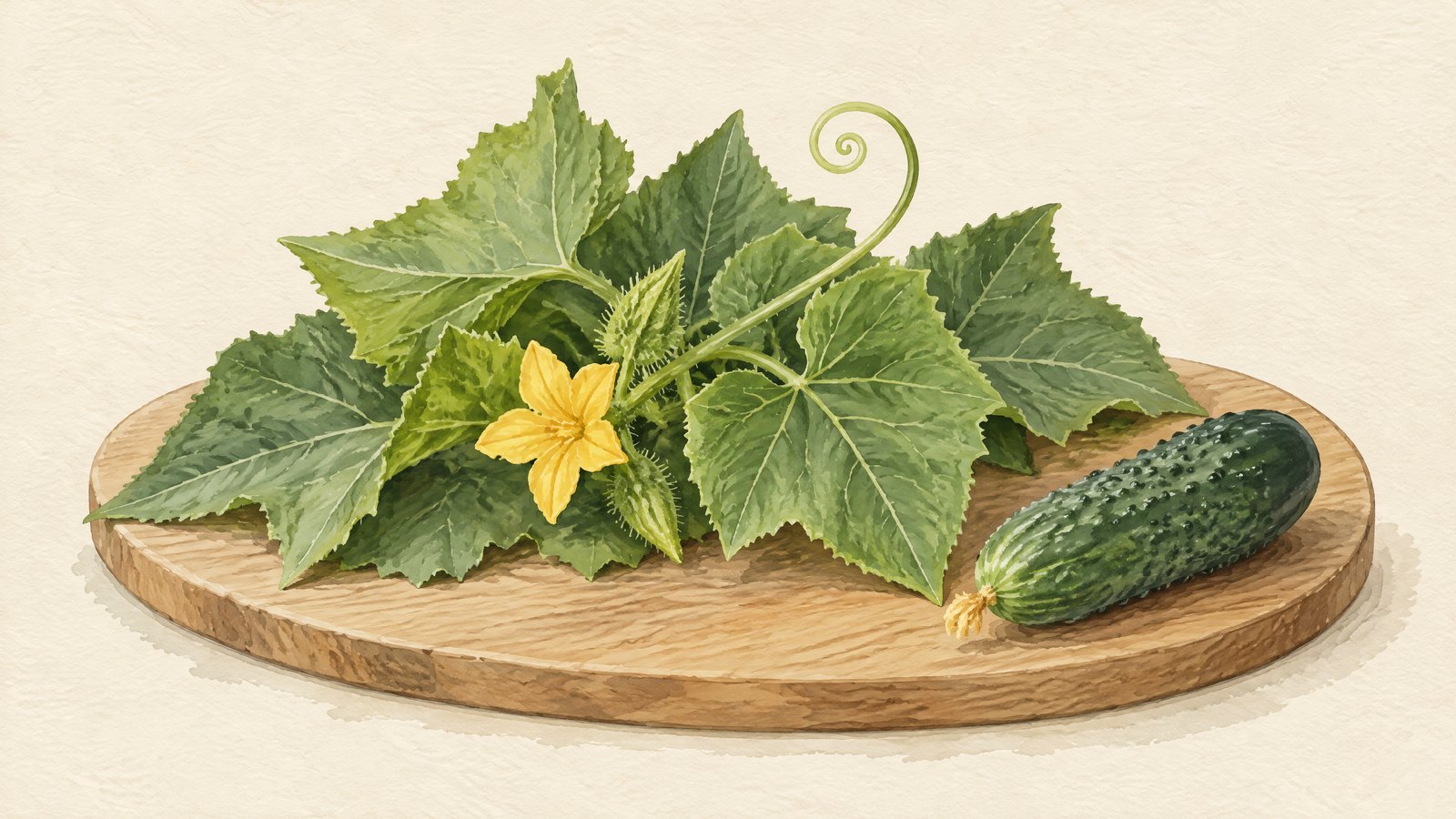

Yes, young cucumber leaves can be cooked as a green, as long as they don’t taste bitter. Bitterness means cucurbitacins, and cooking doesn’t destroy them. A “bitter-free” seed packet may only be talking about the fruit, because leaves and fruit run on separate gene switches. If you’re planting for leaves, our pick is Marketmore 80.
Southern Exposure Seed Exchange sells Marketmore 76 as a “bitter-resistant” cucumber. For a 2023 study, a lab in Switzerland grew Marketmore 76 from Southern Exposure seed and measured 45 µg of cucurbitacins per gram of leaf, in seedlings 15 to 20 days old raised in a growth chamber. Two other varieties in the same test, Tanja and Sonja, stayed under 1 µg/g in every part of the plant measured. Nobody is lying. The seed company is describing the cucumber, and Cornell’s own 1979 table of its releases marks Marketmore 76 as lacking the non-bitter gene. The version with it came next, as Marketmore 80.
The word “burpless” grew out of the same chemistry. Purdue’s extension notes that some people get a burp along with the bitter taste, and that some seed companies called their bitter-free cucumbers “burpless”. If it’s the burp rather than the leaf that brought you here, our page on vegan gas and bloating is the better read.
Why a cucumber leaf can be bitter when the cucumber isn’t
Cucurbitacins are the bitter triterpenoids of the cucumber family, and they discourage most pests on the plant. In 2014 a team publishing in Science identified nine genes in the pathway cucumbers use to make cucurbitacin C, and found two transcription factors running it: Bl (Bitter leaf) in the leaves and Bt (Bitter fruit) in the fruit. Selection on Bt during domestication led to the non-bitter cucumbers we eat. Nothing in that story required the leaves to come along. Purdue’s extension says cucurbitacin can be present in the fruit as well as the foliage.
Stress pushes the levels up. Poison Control lists high heat, drought, poor soil and insect damage as conditions under which squash and other gourds produce high levels of cucurbitacin. A vine that has spent August under beetles may not taste like the one you sampled in June.
The beetles are part of the bargain. A 1971 paper in Science reported that cucurbitacins attract cucumber beetles and get them feeding, while working against two-spotted spider mites, and tied both effects to the bi gene, whose plants lack cucurbitacins. H.M. Munger, of Cornell’s cucumber breeding program, wrote in 1979 that his team had seen non-bitter cucumbers come down with spider mites repeatedly in the greenhouse, and once in the field in 10 or 12 years.
Six cucumber varieties, and what is on record about their leaves
| Variety | Where we read it, and the price on 1 November 2026 | What the seller promises | On record about the leaves | For leaves |
|---|---|---|---|---|
| Marketmore 80 | True Leaf Market, $1.99 for a 1 g packet on sale | Not bitter, more resistant to cucumber beetles | Bred as Marketmore 76 with the non-bitter gene added | Our pick |
| Marketmore 97 | Territorial Seed, $4.95 for 1 g of organic seed | Bitter-free and burpless | Listed by a Cornell project as a non-bitter variety | Yes |
| Diva | Johnny’s Selected Seeds, $6.40 for 30 seeds | Bitter-free cucumbers | Two other sellers call the foliage non-bitter or less tempting to beetles | Probably, taste first |
| Straight 8 Elite F1 | True Leaf Market, $4.69 for 3 g of organic seed | Bitter-free, burpless fruit | Nothing we read | Taste first |
| Garden Sweet Burpless | Gurney’s, $2.99 for about 50 seeds | Bitter-free fruit | Nothing we read | Taste first |
| Marketmore 76 | Southern Exposure, $3.70 for 2 g of organic seed | A bitter-resistant cucumber | No non-bitter gene; 45 µg/g of cucurbitacins in seedling leaves | No |
Prices are what each seller’s page showed on the day we read it, and seed prices move every season.
Marketmore 80
Our pick, because its paper trail runs straight to the gene. Munger’s 1979 note describes Marketmore 80 as resistant to scab, cucumber mosaic virus and the mildews, like Marketmore 76, “but with non-bitter gene added”, and a Cornell project four decades later used the two as a near-identical bitter and sweet pair. True Leaf Market had the 1 g packet at $1.99 on sale, down from $2.79, and puts the seed at about 1,000 to the ounce.
The same note says Marketmore 80 is more susceptible to mites and rabbits, so you won’t be the only one in the garden after the leaves. Munger advised caution with non-bitter types wherever mites are known to be a problem, so if spider mites take your cucumbers every summer, think twice before planting it.
Marketmore 97
Territorial Seed sells it under a Cornell license and calls it bitter-free and burpless, and one of the most disease-resistant varieties it sells. Cornell’s licensing sheet calls it a bitter-free slicer with resistance to cucumber mosaic virus, powdery mildew, downy mildew and scab, and the Cornell beetle project names it next to Marketmore 80 as a non-bitter variety less susceptible to striped cucumber beetles. On 1 November the 1 g packet, at $4.95, was the only size listed as available; the 4 g, 1 oz, quarter pound and pound sizes were sold out. Munger’s mite warning was written about non-bitter cucumbers in general, so it travels with this one too.
Diva
Johnny’s Selected Seeds sells Diva as seedless, thin-skinned and bitter-free, at $6.40 for a packet of 30. That is a promise about the cucumber. The leaf claim comes from other shops: Reimer Seeds says the foliage is non-bitter and less attractive to cucumber beetles than some varieties’ foliage, and Gurney’s says the foliage tempts beetles less than other varieties. We’d give it more weight if Johnny’s page said it. At about 21 cents a seed from Johnny’s, or 14 cents for Gurney’s packet of about 35 at $4.99 (our arithmetic), Diva is a cucumber you buy for the cucumbers. It is parthenocarpic, setting fruit without pollination. Taste a leaf before you cook any.
Straight 8 Elite F1
True Leaf Market describes this organic hybrid as an improved Straight Eight bred with bitter-free fruits and a more compact habit, lists its flavor as burpless, and sells a 3 g packet for $4.69. A glossary further down the same page says burpless cucumbers have reduced cucurbitacin and draw fewer beetles, which is a definition of a category rather than a measurement of this plant, and nothing on the page says whether its leaves are bitter. If you want greens from it, taste one before it sees a pan.
Garden Sweet Burpless
About 50 seeds for $2.99, billed by Gurney’s as its highest-yielding burpless variety, with bitter-free fruits 10 to 12 inches long. The bitterness claims on the page are about the fruit, which is how some seed companies have used “burpless”. At about 6 cents a seed (our arithmetic) it’s a cheap packet of long slicers, and the page says nothing about whether the leaves are bitter. Buy it for salads. If you want greens from the same bed, plant a row of Marketmore 80 beside it.
Marketmore 76
This is the plant from the top of this page. Southern Exposure sells organic Marketmore 76 at $3.70 for 2 g, about 60 to 80 seeds, and Johnny’s sells its organic seed at $6.80 for 30. Johnny’s says the 8 to 9 inch fruits stay uniformly dark green even under weather stress. Munger’s table marks it without the non-bitter gene, and its seedling leaves are the ones the 2023 study measured at 45 µg/g. If it’s already in your garden, pick the cucumbers and leave the leaves on the vine.
How to check a leaf before it goes in the pan
Pick young ones. ECHO’s plant database lists young leaves and stems as a cooked green, and notes that cucumber leaves are hairy on both sides. We’d cook them for that alone.
Then taste a small corner raw. Poison Control’s advice for squash, pumpkin, zucchini and cucumber is to take a very small taste, and if it is bitter, to spit it out and throw it away. That advice was written for the fruit. We use the same test on a leaf, because the bitter compound is the same one in both. Don’t try to cook a bitter leaf into something better. Poison Control says the toxin is not inactivated by heat, and lists diarrhea, nausea, vomiting and abdominal pain as the main symptoms of toxic squash syndrome. Taste again in late summer, when heat and beetles have had their turn.
Last, think about what went on the vines. The EPA crop group that covers cucumber when pesticide tolerances are set for the group lists cucumber alongside chayote (fruit), melons, pumpkin and squash, names no cucurbit leaf, and says a commodity not listed is not included. If you sprayed and the label says nothing about eating leaves, eat the cucumbers and compost the leaves.
Plant Marketmore 80 if leaves are part of the plan, taste every batch before it hits the pan, and for a cooked green with absorption figures behind it, our calcium page puts kale and spinach side by side.
Sources
- ECHO plant database, Cucumis sativus (cucumber)
- Poison Control (National Capital Poison Center), Toxic squash syndrome: if it’s bitter, it’s not dinner
- Shang et al. (2014), Biosynthesis, regulation, and domestication of bitterness in cucumber, Science
- Southern Exposure Seed Exchange, Marketmore 76 Cucumber Seeds, Organic
- Bruno et al. (2023), Sequestration of cucurbitacins from cucumber plants by Diabrotica balteata larvae, Journal of Pest Science (open access)
- Munger (1979), A summary of cucumbers released from the Cornell breeding program, Vegetable Improvement Newsletter No. 21 (Cucurbit Genetics Cooperative)
- Purdue University Consumer Horticulture (2006), Bitter cucumbers a temporary problem
- Da Costa and Jones (1971), Cucumber beetle resistance and mite susceptibility controlled by the bitter gene in Cucumis sativus, Science
- True Leaf Market, Marketmore 80 cucumber seeds
- Territorial Seed Company, Marketmore 97 cucumber
- USDA NIFA project at Cornell University (2018 to 2021), Cucumber cucurbitacins: impacts on beetles, pollinators and disease
- Johnny’s Selected Seeds, Diva cucumber seed
- Reimer Seeds, Diva cucumber seeds
- Gurney’s, Diva cucumber seed
- True Leaf Market, Straight 8 Elite F1 hybrid cucumber seeds (organic)
- Gurney’s, Garden Sweet Burpless hybrid cucumber
- Cornell Center for Technology Licensing, cucumber varieties sheet (Marketmore 97)
- Johnny’s Selected Seeds, Marketmore 76 organic cucumber seed
- eCFR, 40 CFR 180.41, crop group tables (Crop Group 9, cucurbit vegetables)