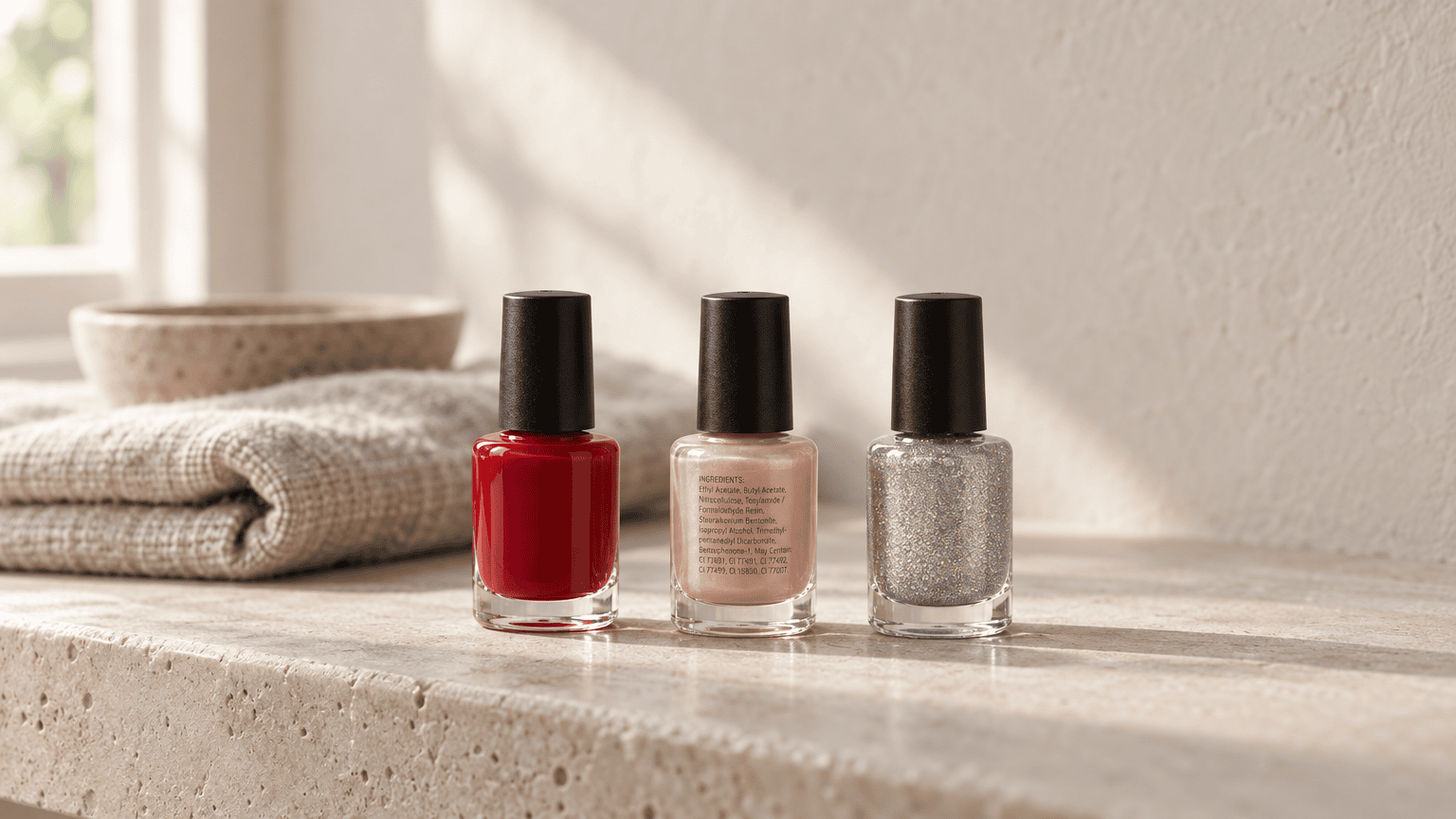

Nail polish is vegan only when its ingredient list rules out carmine, fish-derived guanine and shellac. The color tells you where to look. Carmine (E120) is a red made from cochineal insects. Guanine is the pearly shimmer, and it can be taken from fish scales or made synthetically.
In the US, carmine cannot hide in a cosmetic. An FDA final rule published on January 5, 2009 requires cochineal extract and carmine to be declared by name on the label of all food and cosmetic products in the United States. The rule reaches past the usual ingredient list, too. Even a cosmetic that falls outside 21 CFR 701.3 must declare carmine “prominently and conspicuously at least once in the labeling”. Nothing we read for this article gives guanine the same treatment. That turns the usual worry around. The red bottle is the easy one to read. The pearly nude is the one to ask about.
If you want the general method for any product in your bathroom cabinet, our guide on telling whether a beauty product is vegan covers it. This one stays on the nail shelf.
What makes a nail polish not vegan?
An animal-derived ingredient, and in polish the candidates are few. Carmine is the one tied to reds, pinks and some purples, because that is the color it gives. Guanine is tied to finish rather than shade: it is a crystalline material that catches light, which is why it turns up in shimmers and pearls. Shellac is a resin secreted by the lac insect, and it has its own explainer on why shellac resin isn’t vegan.
Shimmer has a plant-free, animal-free option as well. Mica is a mineral, and a sparkle built on mica and synthetic pigments has no animal in it. The front of the bottle is not where you find out which kind of sparkle you are holding. The ingredient list is.
Why is guanine harder to catch than carmine?
Because the word on the label doesn’t settle where it came from. Guanine from fish scales and guanine made in a lab are the same compound. Nothing we read for this article requires a label to say which one went in. Carmine has a federal rule forcing its name onto the packaging. Guanine leaves you emailing the brand.
I have stood in a drugstore aisle long enough with a champagne-colored bottle to know that the ingredient list is printed in a size designed for ants. That is the whole case for knowing the two or three words you are scanning for before you go in.
Which nail polish brands are vegan?
Three lines below, each checked against the brand’s own page. Vegan status is stated as the brand states it, and the last column is what the evidence does not cover.
| Brand and line | Vegan? | What it rests on | The catch |
|---|---|---|---|
| OPI Nature Strong | Yes | OPI says the line carries the Vegan Society certification | Covers Nature Strong only, not the rest of OPI |
| Sally Hansen Good. Kind. Pure. | Yes | Sally Hansen calls it “100% vegan” and lists animal-derived ingredients among what it is formulated without | Self-declared, no certification mark in what we read |
| Holo Taco | Yes | Holo Taco says its polishes are “vegan, cruelty-free” | Self-declared, and the statement is about polishes, not every product it sells |
OPI Nature Strong is the only one of the three with a third-party mark behind it in what we read. OPI’s own page says that to carry the sunflower trademark it had to meet the Vegan Society’s standards. The flaw is scope. The certification belongs to Nature Strong, and nothing we read extends it to OPI’s main lacquer range. If the shade you want is a classic OPI color outside Nature Strong, this line does not answer the question for that bottle.
Sally Hansen Good. Kind. Pure. puts its vegan claim in writing in two places. The product page lists 16 things the formula is made without, and “Animal-derived ingredients” is number 11, filed between triphenyl phosphate and styrene as if it were one more chemical. That is a perfectly good statement of formulation. It is also the brand’s own word, with no certification body named on the page we read, so if you only buy polish with an independent vegan mark, skip this one. It also says nothing about Sally Hansen’s other lines, which you should treat as unchecked.
Holo Taco states that its polishes are vegan, cruelty-free and made in the USA. For a brand with “holo” in its name, the sparkle is the whole product, and the sparkle is exactly where guanine would hide. The brand’s word “vegan” is meant to cover it. That statement is self-declared, so the reader who wants an audited mark should go to OPI Nature Strong instead.
Which one should you buy?
Our pick is OPI Nature Strong, because a Vegan Society trademark is a claim someone outside the company had to sign off on, and the other two lines rest on the brand’s word alone. That is the whole basis for the pick. We have not worn, chipped or timed any of these, and this is not a ranking of how the polish performs.
Don’t buy Nature Strong if the color you are after only exists in OPI’s regular range. In that case the certification is irrelevant to your bottle, and you are back to reading that bottle’s label. If you are happy with a brand’s own declaration, Sally Hansen Good. Kind. Pure. and Holo Taco both put “vegan” in writing on their own sites, which is more than plenty of bottles do.
How to check a bottle yourself
Turn it over and read the full ingredient list, not the front. If you find carmine or cochineal in a US product, the answer is no and you are done, because the FDA rule means it has to be named.
If you find guanine, the label has not answered the question. Write to the brand and ask whether its guanine is synthetic. A brand that can’t or won’t tell you has given you an answer of a sort.
If you find a vegan claim on the front, look for whose claim it is. A Vegan Society sunflower means the brand applied to an outside scheme. The word “vegan” printed without a mark means the brand is vouching for itself, which can be true and is still a different thing.
If the bottle lists guanine and the brand can’t say it is synthetic, put it back and pick up OPI Nature Strong. For the rest of the makeup bag, our list of vegan drugstore makeup brands is the next shelf to read.
Sources
- FDA 2009 rule requiring carmine and cochineal extract to be declared by name on US cosmetics
- OPI’s statement that Nature Strong carries Vegan Society certification
- Sally Hansen’s own vegan and 16-free formulation claims for Good. Kind. Pure.
- Holo Taco’s own statement that its polishes are vegan and cruelty-free