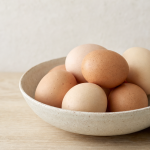
Eating eggs from rescued hens is not vegan by this site’s line, and the best reason is about the hen herself. Commercial stock is bred to lay around 300 eggs a year against roughly 10 to 20 for wild red junglefowl, and some sanctuaries feed the eggs back to the hens still laying them.
No study will settle this. It is a question about where a line sits, the same kind of question as whether vegans should eat lab-grown meat, where the obvious harm has been taken off the plate and people still disagree about what is left. So what follows gives each side its best version, then says where this site stands, and which part of that stance it is least sure of.
The case for eating them
Put it at full strength, because the people who make it are not looking for a loophole. The hen was taken out of a laying shed, or out of a backyard that no longer wanted her. Nobody paid a hatchery for her. Nobody profits when she lays. She lays whether the egg is eaten or not, because laying is what her breeding does, and nothing the keeper asks of her changes it. An egg left in the nest box spoils. An egg thrown on the compost feeds nobody.
If veganism exists to reduce what animals go through, the argument runs, it is hard to point at the harm in a boiled egg from a hen living out her life on grass, with her vet bills paid by the person eating it. Those who make the case add that an egg from the garden is one fewer bought from a shop, and that calling the keeper non-vegan turns the word into a score kept on the person rather than a description of how the animal is treated.
That is a serious position. It is consistent, it rests on harm rather than on rules, and anyone who has spent money and time rehoming hens has earned the right to make it.
The case against, and what the hen’s body adds
The usual objection is about the system the hen came from. A rescued hen breaks the money chain for herself, but a household that comes to value her eggs has a reason to take the next hens for the eggs as much as for the rescue, and the gap between a sanctuary and a small egg farm gets thin without anyone deciding it should. The egg also stays what it was in the shed, something taken from her because a person wants it.
Open Sanctuary’s guidance on residents’ eggs describes egg production as so taxing that hens who are actively laying may benefit from the extra nutrients in an egg. It says some sanctuaries feed eggs back to their laying hens, and that a popular method is to scramble them, or hard boil and smash them, often with the shell crumbled in to give laying hens more calcium. It adds that some veterinarians recommend supplementing calcium on top of that, even for hens already on a feed formulated for layers. The same page says healthy chickens who are not laying likely do not need the extra calories, protein, fat and calcium.
On that guidance’s own account, then, the hen producing the eggs is the hen it says may benefit from eating them. That changes what the waste argument is about. The egg in the nest box is not food with nowhere to go. It has an obvious place to go, and it is back to her.
Where this site draws the line
This is the site’s line, a judgement on a belief question and not a settled fact. Eating eggs from rescued hens is not vegan, and a household keeping them should feed the eggs back to the hens who are laying, cooked and with the shell, as the sanctuary guidance describes. We do not think a keeper who eats one has done the same thing as someone buying a carton, and we would not tell them so. The harm argument for eating the eggs is the strongest case on its side, and we take it seriously.
We hold the line anyway for two reasons. The first is the hen: while she is laying hard, her own eggs are something the guidance we read says she may use, and a person who takes them is taking that from her. The second is what wanting the eggs does to the arrangement. A hen kept partly for what she produces is an egg source with a name, and the word vegan is meant to describe a life where animals are not kept for what they produce, however kindly.
Set the dose of any calcium supplement, and decide whether a particular hen should eat eggs at all, with an avian vet. That is a question about one bird, and this article is not.
What we have not resolved is the surplus. A flock of young ex-commercial hens may lay more than its own laying hens should eat back, and the guidance we read says the non-layers likely do not need eggs. For those leftover eggs the first reason falls away, and our answer rests entirely on the second, the argument about what wanting the eggs does. It is the weaker of our two reasons, and we are less sure of it than of anything else here. If you keep rescued hens, what do you do with the eggs the flock cannot use?