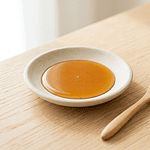
Vegans who eat honey draw the line at suffering rather than at use, and that line breaks down at the hive, because beekeeping is the management of an animal. One standard queen-management practice clips a mated queen’s forewing so that, if she tries to leave with a swarm, she falls to the ground in front of the hive.
That detail does more work in this argument than any amount of speculation about what a bee feels, and it is why this site comes down where it does. To get there fairly, the honey-eating side has to be heard at full strength first, because it is a better argument than the eye-rolling it usually gets.
Where the honey line came from
The reference definition leaves no room. The Vegan Society’s definition of veganism says that what all vegans have in common is a diet “avoiding all animal foods such as meat (including fish, shellfish and insects), dairy, eggs and honey”. Insects are named inside the meat clause. Honey gets its own word at the end.
Read literally, a vegan who eats honey is a contradiction in terms. The people who do it anyway are not, in our experience, unaware of the definition. They have read it and decided it applies the wrong test.
The definition’s test is use. Bees are animals, honey is taken from them, so honey is out, in the same way wool and leather are out without anyone needing to prove a sheep or a cow is unhappy about it. If you want the longer story of how that definition became the reference point, our piece on how veganism began covers it.
The honey-eater’s test is suffering. On that test, the question stops being “is this from an animal?” and becomes “is anyone being hurt, and how badly?” Those two tests agree almost everywhere. A dairy shed fails both. Honey is one of the few places where they come apart, which is exactly why it has become the argument it is.
The strongest case for the spoon
The best version of the honey-eating position does not say bees do not matter. It says veganism earns its moral force from cases where we are confident an animal suffers, and that bees are not one of those cases. A cow separated from a calf is not a hard call. Whether a bee experiences anything at all is something the sources we read for this article do not settle, and a movement that prides itself on evidence should not treat an open question as a closed one.
The second argument is strategic, and honey-eating vegans make it with some heat. As they put it, a rule that looks fussy to an outsider may cost the movement people who would otherwise have stopped eating meat and dairy, where the case for harm is strongest. If the honey rule is what makes veganism read as a purity test, the argument goes, enforcing it is a bad trade. Whether veganism’s gains are counted in animals or in principles is a question we have taken up before, in does veganism really help animals.
Put together, this is a serious position held by people who have thought about it. It deserves better than the response it usually gets, which is someone telling them they are not a real vegan and leaving it there.
Our line, and why the hive matters
This is the site’s line, not a settled fact, and we hold it knowing the other side has a case: no honey.
The reason is that the honey-eater’s test, applied honestly, does not need the bee-sentience question answered. Go back to the wing clip. The University of Florida guide that describes it is plain about what it is for. Clipping, it says, is “a management practice to recover queens and bees after a swarming attempt”, and it “does not reduce stimuli for a colony to swarm” (University of Florida IFAS). The colony still decides to leave. The clip exists so that it cannot take its queen with it.
That is an animal’s own behaviour being overridden so the keeper keeps the colony. You do not have to believe a bee feels pain to see it. It is the definition of use, sitting inside an argument that was trying to get away from use, and it is the reason the suffering test does not deliver the verdict honey-eaters want from it.
Uncertainty points our way too. When you do not know whether a being can suffer, and the product in question is a sweetener, the cost of caution is close to nothing. Maple syrup and agave do the job in our kitchen. Refusing honey asks very little of anyone, which is a strange thing to describe as a purity test.
None of this makes honey-eating vegans frauds, and treating them that way is how the movement earns its reputation. Our own practice, when someone says they eat honey, is to ask which test they are using, and to have the conversation from there. If that conversation tends to go badly for you, our notes on answering criticism without a fight and on why vegans come across as intolerant are the place to start.
The part of this we are least sure about is the hardest case: a small keeper who never clips a wing, never replaces a queen, and takes only what the colony will not miss. Our argument leans on management practices, and a keeper who uses none of them leaves us holding only the uncertainty argument, which is thinner than we would like. If a hive is barely managed at all, is the honey from it still a product of use?