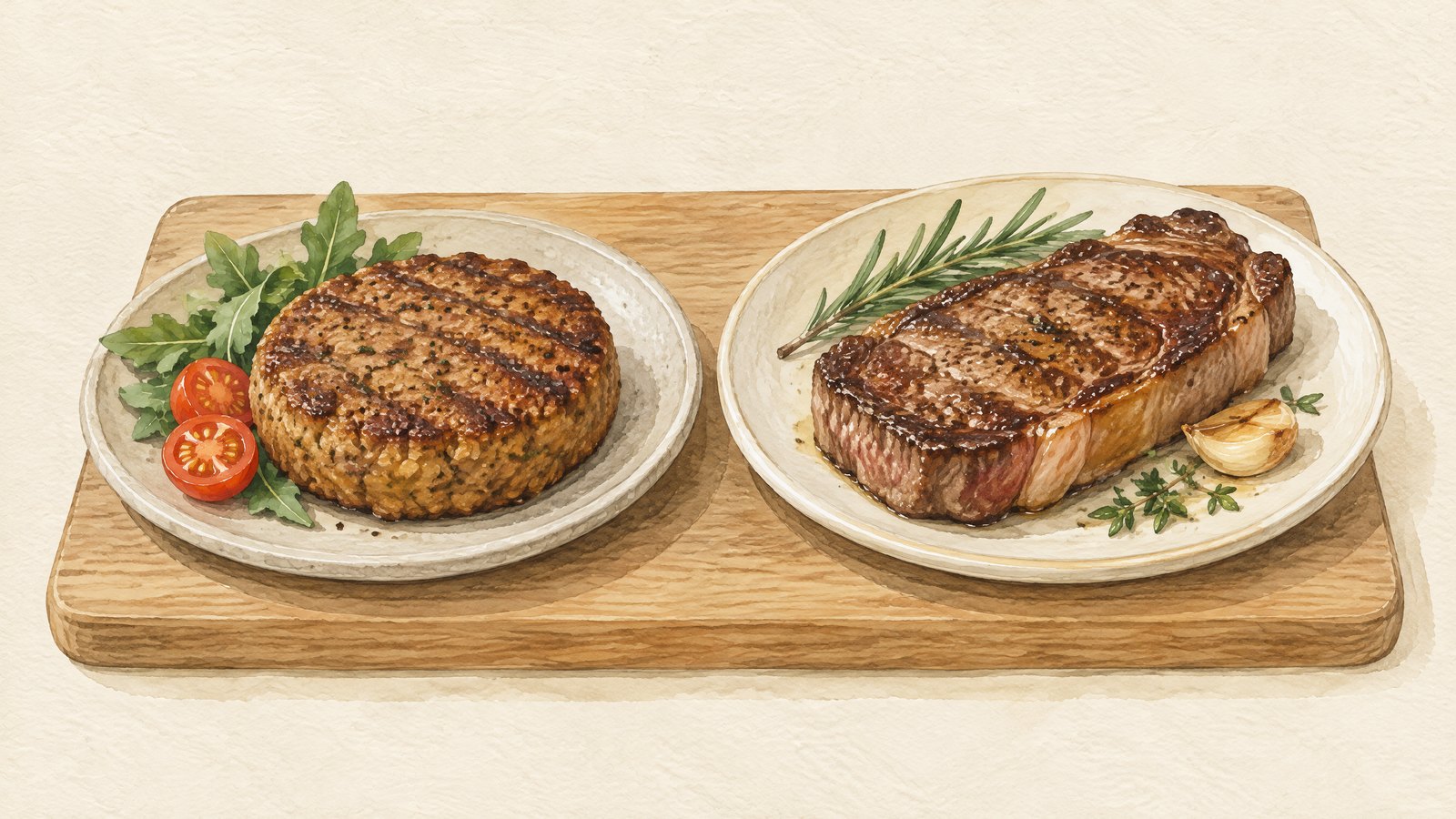

Veganism looks popular because its food is. Sixty percent of US households bought plant-based food in 2025, but polls put US vegans at 1% to 3% of adults. The households buying plant-based meat nearly all buy animal meat too, and Americans cutting back on meat have told Gallup they mostly do it for health and the environment.
The industry says so itself, and cheerfully. In its report on 2025 sales, the Plant Based Foods Association found that in every US region, 95% to 96% of plant-based meat shoppers also bought animal meat. It presented that as good news for retailers, since a shopper who buys both could mean a bigger basket and an openness to more plant-based options as stores add variety. Fair enough from where a store stands. A movement whose definition, first proposed in 1949, is about freeing animals from exploitation has a harder time counting a plant-based burger riding home next to a pack of ground beef as a win. If you have ever wondered what is in those burgers, our look at how vegan meat is made reads the labels.
How many Americans are vegan? Two polls, two answers
Gallup asks people whether they consider themselves vegan. In July 2023, 1% of US adults said yes, against 3% in 2018 and 2% in 2012, and Gallup called the 2023 figures similar to the earlier readings. The 2023 poll reached 1,015 adults by phone.
The Vegetarian Resource Group asks a stricter question. Its January 2026 Harris poll of 2,096 adults didn’t ask what people call themselves. It asked what they never eat, and counted as vegan anyone who never eats meat, fish, seafood, poultry, dairy or eggs. VRG warns that because it uses the word never, its numbers may come out lower than polls that rely on self-description. They came out higher than Gallup’s 2023 figure, at 3%, roughly three times as high (our arithmetic) and level with Gallup’s 2018 reading. The two polls were fielded about two and a half years apart (our arithmetic) with different methods, so I wouldn’t read a trend into the gap, only a range. The same VRG poll found that 13% of adults always or usually eat vegan meals and 33% do at least sometimes.
People also leave. In Faunalytics’ 2014 survey of people in the US aged 17 and over, 84% of people who had ever been vegetarian or vegan had stopped, and about a third of those who stopped had kept it up for three months or less. In 2021 Faunalytics said it puts more stock in that abandonment rate than in its later figures, though a one-off snapshot like this is not ideal for working out why people quit.
Who buys the food, and why people cut back
US retail sales of plant-based food reached $7.9 billion in 2025, more than double the $3.3 billion of 2018, and 78% of the households that bought some went back for more. Gallup spotted the pattern back in 2018. Sales were climbing while the share of vegans and vegetarians wasn’t, which it read as Americans being eager to bring alternatives into their diets without giving up animal products completely.
Gallup’s 2023 report says Americans who ate less meat typically cited health and environmental reasons, a finding it links to an earlier Gallup survey. Those are reasons for eating less meat rather than for buying any particular product. The same goes for the Faunalytics study. Majorities of current vegetarians and vegans there cited health (69%), animal protection (68%), disgust at animal products (63%), the environment (59%) and taste (52%), while among former ones the only reason a majority cited was health, at 58%. Health was the one reason a majority of both groups gave. Given what Faunalytics says about its own snapshot, that is a pattern rather than proof of a cause, but it is the pattern I would worry about if I sold oat milk on health alone. Whether vegans do end up healthier is its own argument, and the big cohort studies give a mixed answer.
Where the word came from
The Vegan Society traces the idea back more than 2,000 years, to Pythagoras promoting benevolence among all species around 500 BCE and to the Buddha discussing vegetarian diets with his followers in the same period. By its account, Dr William Lambe and Percy Bysshe Shelley were among the first Europeans to object publicly to eggs and dairy on ethical grounds, around 1806.
The word is much younger. In November 1944 Donald Watson called a meeting with five other non-dairy vegetarians, Elsie Shrigley among them, and the group wanted something more concise than “non-dairy vegetarians”. They turned down dairyban, vitan and benevore, which I count as the movement’s first good decision. Watson built vegan from a suggestion by George and Fay Henderson, who wanted to call the society Allvega and its magazine Allvegan. That makes the word 82 years old this year (our arithmetic).
In 1949 Leslie J Cross pointed out that the society had defined a diet but not veganism, and proposed “the emancipation of animals from exploitation by man”. The society later spelled it out as seeking an end to the use of animals for food, commodities, work, hunting, vivisection and every other use that exploits them. That is where our line comes from. The diet travels well; it sits happily in a cart next to a pack of chicken thighs, and the industry has every right to be pleased about that. What Cross wrote down was never a shopping list, and it is what the society came to mean by the word.
Is veganism growing anyway?
The case that it is doesn’t need the vegan count to rise at all. Gallup measures only a label. A third of US adults eat vegan meals at least sometimes. Even the people who quit don’t end up eating like the average American. Faunalytics found that on average former vegetarians and vegans eat only slightly more than half the daily servings of meat of the US population as a whole, and suggested thinking of them as meat reducers. On that view the movement gains through millions of part-time plates rather than a few more full-time ones, and the shoppers who buy both kinds of meat are where the change happens.
The part I’m least sure about is the vegan count itself. Gallup’s 1% of 1,015 people works out to roughly 10 people’s worth of answers, and VRG’s 3% of 2,096 to roughly 63 (our arithmetic; both polls weight their samples and round their percentages). Neither number can carry much on its own, and I’ve built a good part of this page on them.
So here is the question I can’t settle, and you may be better placed to. If the food keeps selling to six households in ten while the vegan share sits still, are the animals better off, or only the stores? It comes down to how much meat those carts leave on the shelf, which our piece on whether veganism really helps animals argues is a question of odds rather than a count.
Sources
- Plant Based Foods Association, Plant-based foods are a staple in American households: regional data (June 2026, 2025 sales)
- Gallup, In U.S., 4% identify as vegetarian, 1% as vegan (July 2023 poll)
- The Vegetarian Resource Group, How many adult vegans are in the U.S.? (Harris Poll, January 2026)
- The Vegan Society, history
- Gallup, Snapshot: few Americans vegetarian or vegan (July 2018 poll)
- Faunalytics, summary of the study of current and former vegetarians and vegans (2014 survey)
- Faunalytics, The complexity of going veg (2021), on the 2014 study’s method