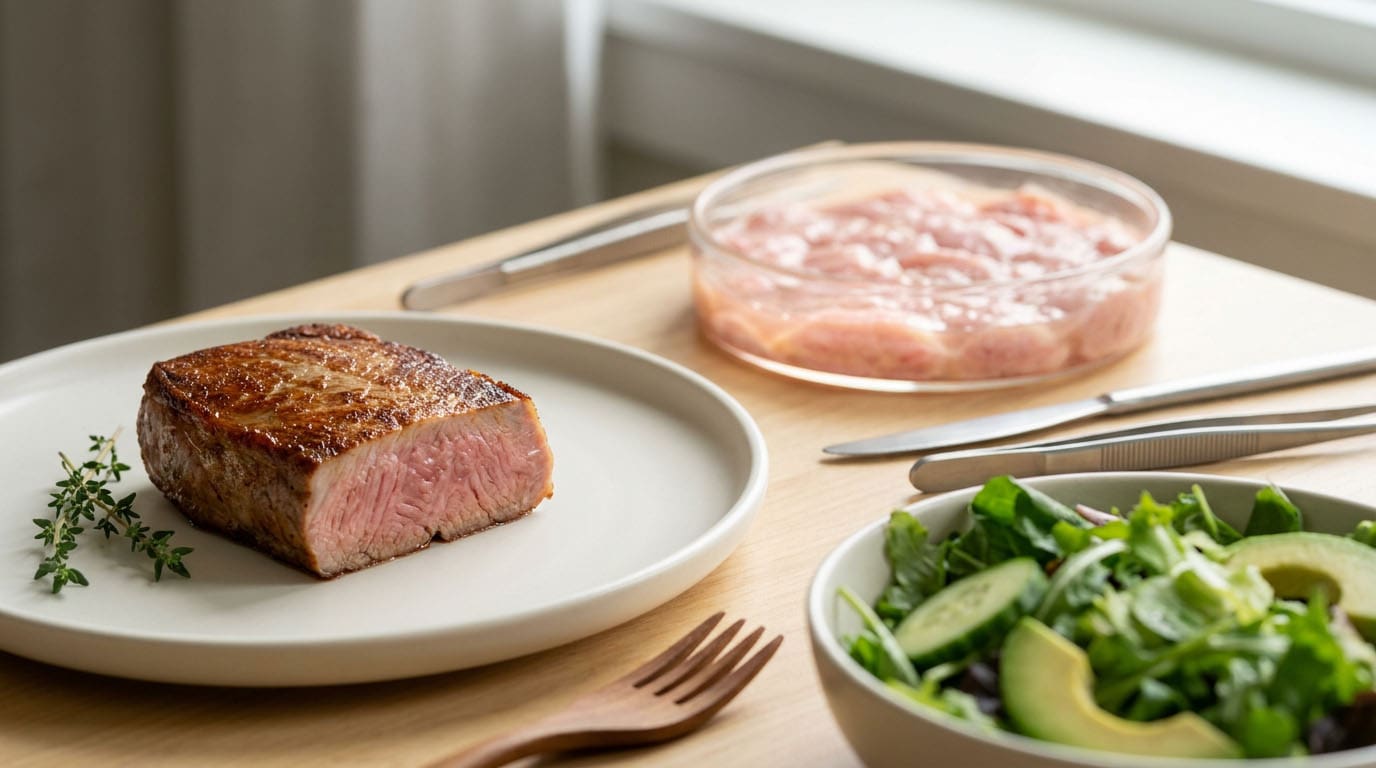

Vegans should not eat lab-grown meat yet, and the reason lies somewhere most arguments never look. The cells on the plate hurt nobody. The objection sits upstream, in the animals a production line may still need for starter cells and, in some processes, for the liquid those cells grow in. Whether that is true of a given product is checkable.
Where the animal is still in the process
Cultivated meat, which is the industry’s own preferred name for it, begins with cells taken from an animal. Those cells come either from a biopsy of a living animal or from a cell line that was started from one at some point in the past. They are then fed a nutrient medium and grown in steel tanks until there is enough tissue to sell.
The medium is where the trouble has historically been. The standard growth supplement in cell culture for decades has been fetal bovine serum, drawn from the blood of calf fetuses removed from cows at slaughter. Several cultivated meat producers have said publicly that they have developed or switched to serum-free media. The cell line is the second question. Some lines keep dividing more or less indefinitely once established, and others tire out and need fresh cells, which means fresh biopsies, on some schedule.
So “lab-grown meat” names a spread of processes. At one end sits a product that depends on a steady supply of slaughterhouse serum, which is a meat industry byproduct wearing a lab coat. At the other sits a product whose cells came from one biopsy years ago and whose tanks have not touched an animal since. Those are morally different foods. As far as we can tell, nothing on the package is required to say which one you are holding.
The strongest case for eating it
The best argument for a vegan eating cultivated meat is made by vegans, and it runs on the movement’s own definition. The Vegan Society defines veganism as excluding animal exploitation “as far as is possible and practicable.” That phrase commits a vegan to reducing harm, and it concedes that zero is out of reach. Crop farming kills field animals during planting and harvest, and vegans eat crops anyway, because that is the practicable choice.
Held to that standard, cultivated meat looks good. Count animals. A single biopsy, taken under anesthetic from an animal who then walks away, set against every animal a meat eater would otherwise eat over a lifetime, is not a close comparison.
People who make this case go further. They argue that a vegan eating cultivated meat in public tells meat eaters something vegans have been saying for years, which is that the objection was always to the killing and the taste of meat was never the problem. They also argue that early demand is what brings a new food’s price down, so the vegans most opposed to slaughter are exactly the ones who should be buying first. And for someone who went vegan for the animals and still misses meat, it offers the food back without the thing that made them give it up.
This is a serious position, argued by people who care about the same animals we do. It is the one we would hold if we could see inside the tank.
Why a vegan’s portion spares nobody
Vegan Pots does not call cultivated meat vegan, and does not recommend that vegans eat it while its inputs cannot be verified. That is the site’s line, and because it is a position on where a line falls, we mark it as ours rather than as settled.
The steelman works for the clean end of the spread, the old biopsy and the serum-free medium. It does not work for the other end, and a shopper currently has no way to tell the two apart. “Possible and practicable” cuts against eating here, because abstaining from a product you cannot check costs a vegan nothing. There is tofu in the fridge.
The second reason is the one the steelman skips. Cultivated meat does its moral work by replacing meat. Every animal in the count above is an animal a meat eater would have eaten, and the arithmetic only comes out so lopsided because of that. When a vegan eats cultivated chicken, it replaces a bean burger, and a bean burger killed nobody. On the steelman’s own arithmetic, a vegan’s portion puts nothing on the benefit side and carries whatever the process cost on the other. The demand argument survives this, partly, since a vegan’s money still funds the next tank. Everything else in the count belongs to the people the product was built for.
None of this means a vegan should want cultivated meat to fail. Wanting it to succeed for other people and declining to eat it yourself are compatible, and we hold both. It is also, for most readers, a hypothetical. Singapore approved cultivated chicken for sale in 2020 and the US followed in 2023, while several US states have since banned its sale.
The part of this we hold least firmly is the clean end. Suppose a producer showed, in an audited statement rather than a press release, that its cell line came from one biopsy a decade ago and its medium contains nothing from an animal. The input objection would fall away, and only the zero-benefit argument would remain. That argument says a vegan’s plate spares no animal. It does not say the plate harms one. Is a food that harms no animal, and spares none, vegan? We lean yes, and we have not managed to make the lean hold.