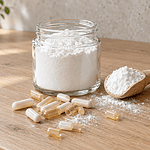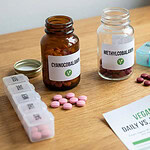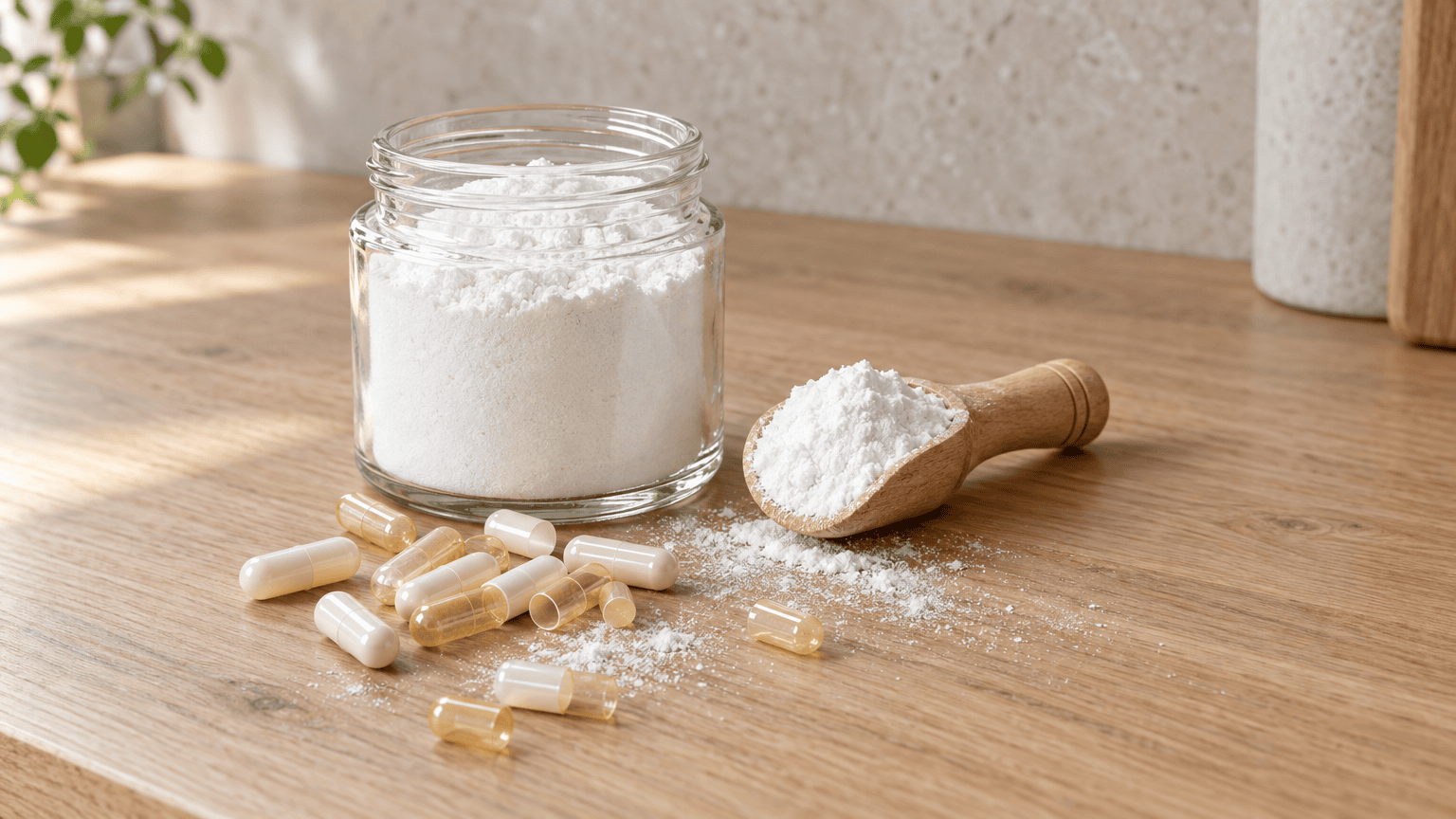

Yes, creatine is vegan when it is made by chemical synthesis rather than extracted from meat. A creatine manufacturing patent describes that synthesis as cyanamide reacted with sarcosine. The catch sits outside the powder. A gelatin capsule or a gummy turns a vegan ingredient into a non-vegan product.
This article does not take up whether you need creatine at all. If you are weighing supplements against what you already eat, our piece on why vegans are not short of protein covers the wider ground. What follows is about the tub in your hand.
Where the creatine in the tub comes from
Creatine occurs in muscle tissue, and the same patent notes that it can be obtained from biological material such as meat waste, then dismisses that method as technically very laborious and questionable for hygienic reasons.
The route the patent itself describes reacts cyanamide with sodium or potassium sarcosinate in water, at a temperature between 20 and 150 °C (68 to 302 °F, our conversion) and a pH between 7.0 and 14.0, as set out in the patent’s own summary. Read the list again and nothing on it comes from an animal. Two starting chemicals, water, heat, a pH window. The creatine that comes out is the same molecule your muscles make, so there is no “synthetic versus real” distinction worth paying attention to.
What a patent cannot tell you is where the creatine in a particular tub was made. That is why a manufacturer that publishes its process is worth knowing by name. Creapure says its creatine monohydrate is made by chemical synthesis from sarcosinate and cyanamide, and that Alzchem Trostberg GmbH, the company behind it, is the only creatine production facility in the Western world. That second line is Alzchem’s claim about itself. It still gives you something a blank label does not: a named plant and a named process you can look up.
Capsules, gummies and what’s mixed in
In the formats on this page, the creatine is not where the problem sits. The delivery format is.
Capsule shells are made either from gelatin, which is animal-derived, or from a plant material such as hypromellose (also printed as HPMC) or pullulan. A capsule product can contain perfectly vegan creatine monohydrate and still be off the table because of the shell around it. Gummies have the same issue in a different form. A gummy has to be set with something, and the two usual setting agents are gelatin and pectin, which comes from fruit.
Flavored powders bring their own list. A red or pink tub may be colored with carmine (E120), which is made from insects. Blends sold as creatine plus vitamins sometimes add vitamin D3, and D3 can be made from lanolin, the grease that comes off sheep’s wool. A line reading “natural flavors” names no source at all, so it is a question for the brand rather than an answer.
| Format | What can make it non-vegan | What to look for on the label |
|---|---|---|
| Unflavored powder | Nothing in the creatine itself | Creatine monohydrate as the only ingredient |
| Flavored powder | Colors such as carmine, D3 from lanolin, unnamed flavors | Every additive named, D3 marked as plant or lichen sourced |
| Capsules | A gelatin shell | Hypromellose, HPMC, pullulan or “vegetable capsule” |
| Gummies | Gelatin as the setting agent | Pectin, and no gelatin anywhere in the list |
The brands we read up on
This section rests on the manufacturers’ own pages. We did not buy or test these products.
Creapure
Creapure is the name we would look for on a label, because it is the only source we read that describes its own manufacturing route. Its weakness is how little it covers. If a label names Creapure, that tells you about the creatine and nothing about the capsule, the flavoring or the sweetener around it. The Creapure page we read describes the process and says nothing about a vegan certificate. If you want a vegan mark on the pack before you spend money, Creapure alone does not give you one.
Thorne Creatine
Thorne’s product page for its Creatine lists NSF Certified for Sport. The passage we read from Thorne’s page says nothing about vegan status either way, and nothing in it ties that mark to vegan status. Do not buy this one on the strength of the mark if what you are checking is vegan status. Read the ingredient panel on the pack, and if the product is a capsule, find the shell material before anything else.
Myprotein Creatine Monohydrate
Myprotein lists its Creatine Monohydrate in its vegan range. The flaw is in the copy. The vegan category page we read describes the creatine as combining pea, faba bean and hemp proteins, which reads like text lifted from a protein blend and does not describe a creatine monohydrate powder. A category page with that kind of error is not something to rely on for a provenance question. Open the product’s own page, read its ingredient panel, and buy only if it lists creatine monohydrate and nothing you have to look up.
What to buy instead of capsules and gummies
If you were reaching for a capsule or a gummy because it is easier, our pick is plain unflavored creatine monohydrate powder with one ingredient on the panel. It removes the shell, the setting agent and the flavor system in one move. The downside is real. Creatine monohydrate dissolves poorly in cold water, so a scoop stirred into a glass leaves grit at the bottom. Our suggestion is to add it to something thicker, and our notes on mixing vegan protein powder into shakes and food work just as well for a scoop of creatine. If you keep both tubs in the same cupboard, the storage habits in our guide to protein powder expiration are a sensible starting point.
If you will not drink grit, powder is the wrong buy for you. A capsule with a named plant shell is the honest trade: you pay for the convenience, and you take on one more ingredient to check.
How to check a tub yourself
Turn the pack around before anything else. The front says creatine; the ingredient panel says what you are actually buying.
- Read the full ingredient list and confirm that creatine monohydrate is the first item and, on an unflavored powder, the only one.
- Find the capsule material on any capsule product, and treat a product that does not name it as unconfirmed rather than vegan.
- Look for a named creatine manufacturer such as Creapure on the panel, which tells you who made the creatine even when the brand on the front did not.
- Check each additive on a flavored tub, starting with colors, any vitamin D3 and anything labeled only as “natural flavors”.
- If the pack carries the Vegan Society trademark or the Certified Vegan logo, look the product up on the certifier’s own site rather than trusting the logo on a photo.
- Email the brand when a line is still unclear, and ask what the capsule is made of and where the D3 comes from.
Creatine is the easy case among supplements. For the one where the molecule itself is the problem, read our piece on whether collagen can be vegan and what to take instead. For creatine, buy the unflavored powder with one ingredient on the panel, and if it has to be a capsule, do not pay until the label names the shell.