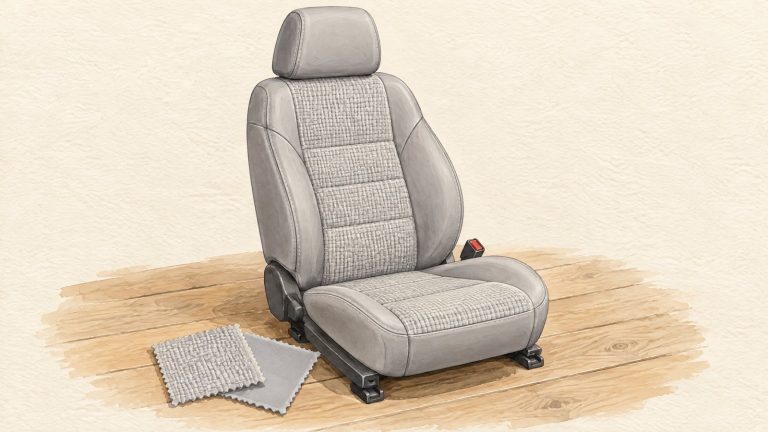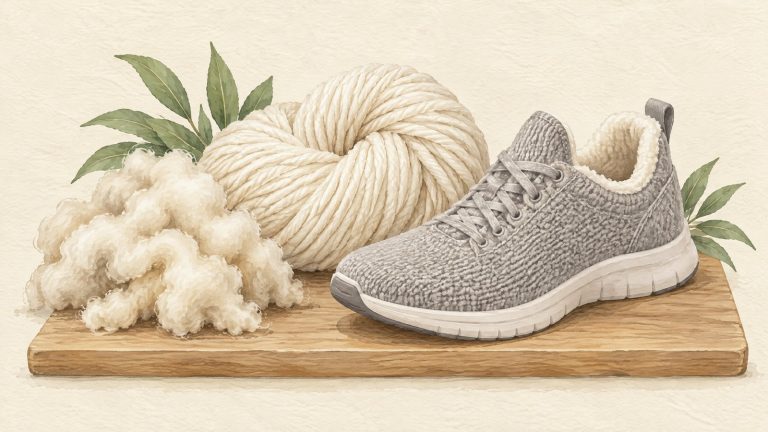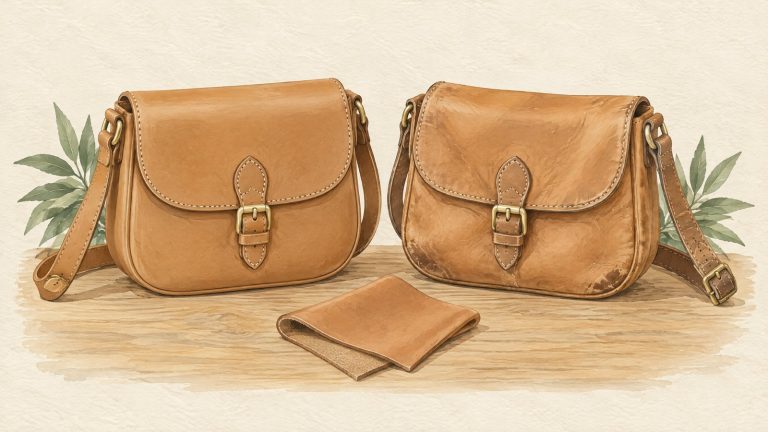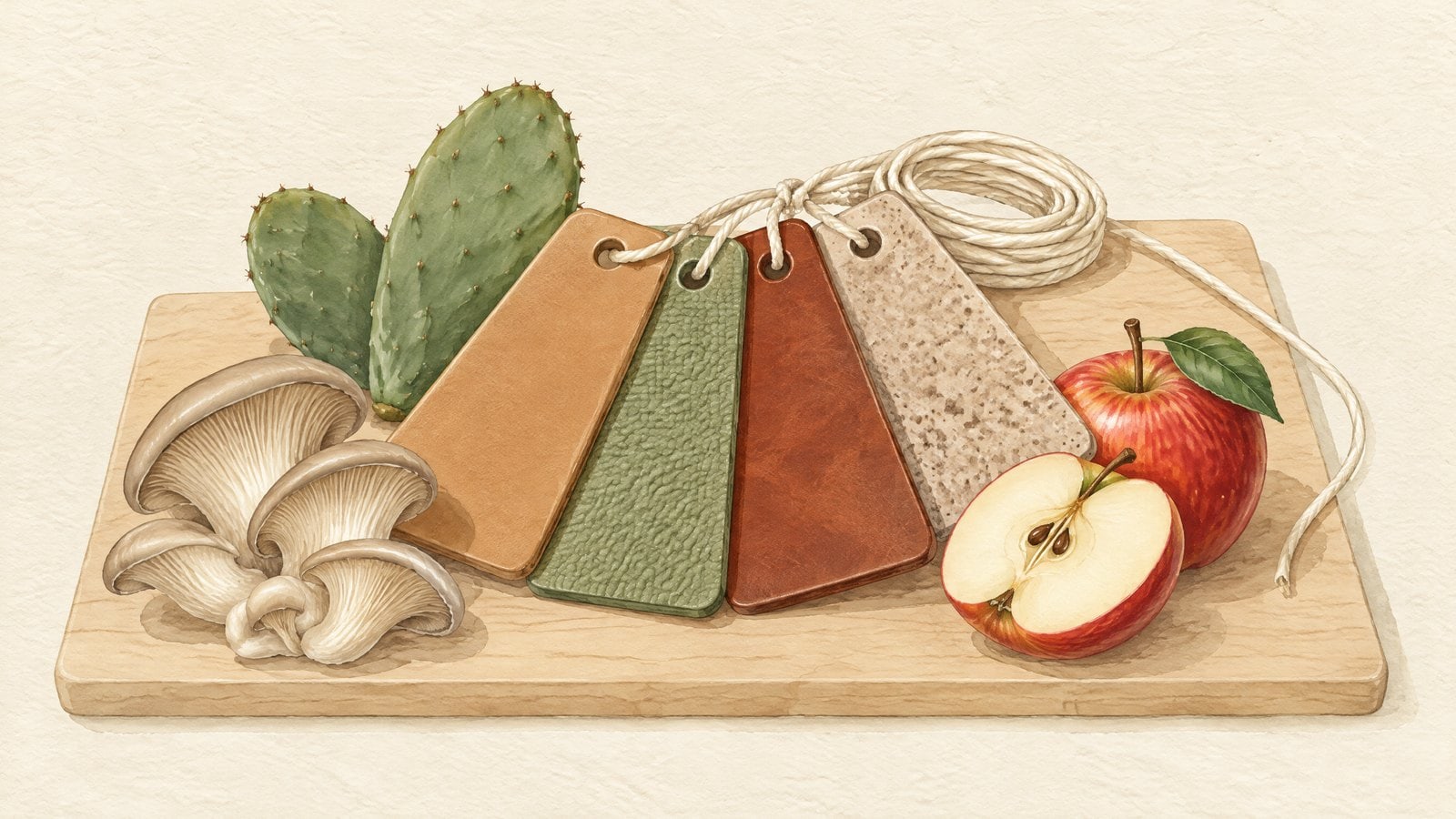

Every type here is made without animal skin, so all five can be vegan. What differs is the plastic. The cactus and apple uppers we read are 65% and 38% polyurethane, and the one mushroom upper we read names none. Our pick is any product that prints its full composition. For the least plastic on paper, take the mushroom one.
MoEa, a sneaker brand, prints the recipe of its apple material on its own site, and the apple is not the biggest number on it. The line reads 26% apple waste, 38% PU, 20% polyester and 16% cotton. Add the two plastics together and, by our arithmetic, they come to 58%, more than twice the apple. The same page calls the material 42% bio-based, which happens to be exactly 26 plus 16, the apple and the cotton together. MoEa does not say how it arrived at its 42%, so treat that match as our arithmetic lining up rather than as its method. Either way, the fruit in the name is about a quarter of what you would be wearing. Plastic content also shapes how a material ages, which our look at how long vegan leather lasts goes into.
PU or PVC: the plain kind, and why the tag rarely says which
Plain vegan leather is a plastic coating on a fabric backing, and the plastic is one of two. Polyurethane, PU, is the one named on the product pages we read. Polyvinyl chloride (PVC, sold as vinyl) is a chlorine-containing plastic that needs added plasticizers to bend like leather. Neither has anything from an animal in it, so the difference between them is not a vegan question.
The trouble is finding out which one you are holding. In the US, the FTC’s guides for leather and imitation leather say a material that looks like leather but is not should be disclosed as such, and the examples they give include “Imitation leather”, “Simulated leather”, “Vinyl” and “Plastic”. Only vinyl tells you which plastic. A tag reading imitation leather, or vegan leather, or synthetic, can be either.
I went looking for a vegan leather product page that admits to PVC in its composition line and came back with none. Every product below names polyurethane, a plant base, or nothing. That is a count of the pages we read for this article, not of the market, and it is why PVC has no product of its own here.
Five products, one per tag, read from the makers’ own pages
Prices are what each maker’s store showed in November 2026. MoEa prices in euros, and the figures below are rounded because the store’s number moves by a euro or two with the country you shop from; its country list does include the United States, priced in dollars. The shipping page we read on its help center lists the European Union and the rest of the world without naming the United States, so check delivery and returns at checkout before you order. Nothing below says how a shoe or a bag wears, because we did not wear them.
Dr. Martens Vegan 1460 Felix
The boot that tells you least about its chemistry does vouch for its construction. Dr. Martens sells the Vegan 1460 Felix for $180 on its US store and describes its upper, Felix Rub Off, as its vegan synthetic material, made with no animal products and designed to imitate the real thing. The page also says the boot is vegan in material and construction, which covers the parts a tag usually skips.
What it does not say is which synthetic. PU or PVC, the page never names it, and it lists no lining material and no outside certifier. The vegan claim is the maker’s own. If you want the polymer named before you pay, this page will not give it to you.
Matt & Nat Dila Vegan Tote Bag (Forum)
Here is the plain kind with the plastic named. Matt & Nat’s US store lists the Dila tote at $155, or $116.25 on sale when we read it, and says the outer body material of its Forum collection is 100% polyurethane, with an interior lining made from 100% recycled plastic bottles. The same page says the company is completely vegan and cruelty-free. That is the brand vouching for itself; no outside certifier is named.
Read the composition again and there is nothing on it that is not plastic: a PU outer, and a lining the page itself traces back to bottles. Recycled is a fair point in the bag’s favor, and it does not make the bag any less synthetic. The 100% is also written for the Forum collection as a whole rather than for the Dila alone, so it is a promise about a range, not a label on this one tote. Don’t buy it if you came to vegan leather to get away from plastic. If you would rather know exactly what you are carrying than guess, it does that job well. Our vegan leather bags roundup reads more bags whose pages name their materials.
MoEa GEN1 Cactus White & Aloe
Desserto, the Mexican cactus material, puts the PU question to itself on its own FAQ. The answer it gives is that Desserto is a different material by formulae, made with its own Bio-Polymer from organic renewable compounds. MoEa, which names Desserto as its cactus supplier, is plainer about the shoe. Its CactusSkin page gives the material as 35% cactus skin and 65% bio-based PU, says production starts at a certified organic cactus farm in Zacatecas, Mexico, and calls the material animal-free and PETA-Approved Vegan. Bio-based polyurethane is still polyurethane, made partly from plant sources, so the FAQ’s answer and MoEa’s number do not contradict each other; MoEa’s simply says more. By our arithmetic the upper carries nearly twice as much PU as cactus. The GEN1 in white and aloe was about €100 on sale and €160 at full price when we read the page.
Desserto says its most advanced materials are 90% bio-based. MoEa’s page does not say which Desserto grade is in the GEN1, so that 90% belongs to Desserto’s best material, not to this shoe. The same FAQ says some of its materials use recycled backers in cotton, polyester, nylon and mixes of them, so the fabric under the cactus layer can be plastic as well, and MoEa’s page does not say which backer the GEN1 uses. If you are choosing cactus because you expect it to break down at the end, Desserto claims only partial biodegradability of finished products, and only under anaerobic thermophilic conditions: no oxygen and high heat, which is not what a garden compost heap offers.
Skip the GEN1 if less plastic is your reason for choosing cactus. Nearly two thirds of the upper, 65%, is polyurethane, whatever share of it came from plants.
MoEa Origin White & Red Apple
This is the material from the opening. MoEa’s AppleSkin page lists it as 26% apple waste, 38% PU, 20% polyester and 16% cotton, 42% bio-based, PETA approved, with production starting in Bolzano in northern Italy, where the material maker Frumat works with the textile company MABEL. The Origin in white and red was about €120 on sale and €160 at full price.
Now open appleskin.com. That site is run by VEGATEX, which sells AppleSkin alongside LemonSkin and BarleySkin and describes its materials as plant waste mixed with water-based polyurethane for the surface, on a bottom layer of lyocell from wood pulp, certified 66% bio-based by the USDA and produced in China. It gives no apple share at all. Asked whether its material is biodegradable, it says it has no official records yet, and adds only that the main raw materials are biodegradable and compostable. Same name, two different descriptions, from two different companies. Which recipe ends up in your shoe depends on who made the shoe, so read the seller’s composition line rather than the material’s home page.
If you want apple to be the main ingredient, do not buy this one. On MoEa’s own figures, it is not.
MoEa Flow (MushroomSkin)
The mushroom upper is the only plant-based one of the five whose page names no plastic. MoEa says MushroomSkin starts with stems and offcuts left behind by mushroom farms in Vietnam, blended with natural latex and bonded onto a base of viscose and lyocell, and calls the result 100% bio-based. It is also the one with the most outside names behind its vegan claim. The page’s own FAQ says MushroomSkin is PETA-Approved Vegan and certified vegan by The Vegan Society. The Flow sneakers in its mushroom range ran from about €90 to €140 by colorway, sale prices included, when we read the page.
The catch is the binder. It is natural latex, so if you avoid latex for any reason, this is your skip. And the 100% bio-based figure comes with no test method on the page, so it is the maker’s number, not a lab result you can check.
“Mushroom leather” also covers a second, different thing, sheets of mycelium grown to size. No maker of that kind whose site we tried would load for us, so this article has no product of that type, and nothing here describes one.
The five side by side
| Product | Type | Composition, per the maker | Plastic named | Vegan claim | Price when read |
|---|---|---|---|---|---|
| Dr. Martens Vegan 1460 Felix | Synthetic, polymer not named | Felix Rub Off vegan synthetic | None named | Maker’s own | $180 |
| Matt & Nat Dila Vegan Tote Bag (Forum) | PU | 100% PU outer (Forum collection), lining from recycled plastic bottles | PU | Maker’s own | $116.25 sale, $155 |
| MoEa GEN1 Cactus White & Aloe | Cactus | 35% cactus skin, 65% bio-based PU | PU, bio-based | Material PETA-Approved Vegan, per MoEa | About €100 sale, €160 |
| MoEa Origin White & Red Apple | Apple | 26% apple waste, 38% PU, 20% polyester, 16% cotton | PU | Material PETA approved, per MoEa | About €120 sale, €160 |
| MoEa Flow (MushroomSkin) | Mushroom | Mushroom farm waste, natural latex, viscose and lyocell base | None named | Material PETA-Approved Vegan and The Vegan Society, per MoEa | About €90 to €140 |
Which type to buy
If you want to know exactly what you are carrying, buy a product that prints its polyurethane share, as Matt & Nat does for the Dila’s collection, and keep the surface clean the way our step-by-step guide to cleaning vegan leather sets out. Plain PU is the honest baseline. It is fully synthetic and it is vegan.
If the point of a plant-based type is less plastic, read the percentages before the plant. On the pages we read, cactus came out at 65% PU and apple at 38%, while the mushroom-waste upper listed no plastic at all. That makes the MoEa Flow our pick for the least plastic named on the page, and it is the only one of the five that names The Vegan Society behind its material. Its flaws are the latex, and a European store with euro prices.
A page that says only “synthetic”, as Dr. Martens does, leaves you buying on the maker’s vegan claim alone. That is a reasonable thing to do for a boot whose page states vegan material and construction. It is not a way to choose between PU and PVC.
How to read a composition line
Start with the percentages, not the product name. A cactus or apple name tells you one ingredient; the composition line tells you its share.
Don’t read bio-based as a plant share. The USDA’s BioPreferred program defines biobased content as the ratio of new organic carbon to total organic carbon, measured with the test method ASTM D6866, so the 66% USDA figure on VEGATEX’s materials is a share of carbon, not of apple. MoEa does not say how it measured its 42%, which is why the neat match with apple plus cotton in the opening is our arithmetic and no more.
Look for the word vinyl. Under the FTC guides it is one of the accepted ways to say a material is not leather, and of the guides’ example words it is the only one that points to PVC.
If a percentage of leather fibers appears anywhere, put it down. The same FTC guides say that a leather-looking material described as bonded leather, or by a similar term, should state its percentage of leather fibers, so a figure like that means hide.
When the page names nothing, as on the Dr. Martens boot, email the maker and ask which polymer it is before you buy, and keep the reply.
For the plant-based materials this page leaves out, such as Piñatex and Mirum, our guide to what vegan leather is is the next read.
Sources
- MoEa, CactusSkin: 35% cactus skin, 65% bio-based PU, Desserto as supplier, PETA-Approved Vegan, GEN1 prices, country list
- MoEa, AppleSkin: 26% apple waste, 38% PU, 20% polyester, 16% cotton, 42% bio-based, Frumat and MABEL, Origin prices
- MoEa, MushroomSkin: mushroom farm waste, natural latex, viscose and lyocell base, 100% bio-based, PETA and The Vegan Society, Flow prices
- FTC, Guides for Select Leather and Imitation Leather Products, 16 CFR 24.2 (eCFR)
- MoEa help center, shipping fees internationally
- Dr. Martens US, Vegan 1460 Felix Lace Up Boots: price, Felix Rub Off, vegan material and construction
- Matt & Nat USA, DILA Vegan Tote Bag (Forum): price, 100% polyurethane outer, recycled bottle lining, vegan statement
- Desserto, FAQ: the PU question, 90% bio-based for its most advanced materials, backers, biodegradability
- VEGATEX, AppleSkin FAQ: water-based PU, lyocell base, USDA 66% bio-based, produced in China
- USDA BioPreferred Program, about: biobased content measured by ASTM D6866 as a ratio of new organic carbon