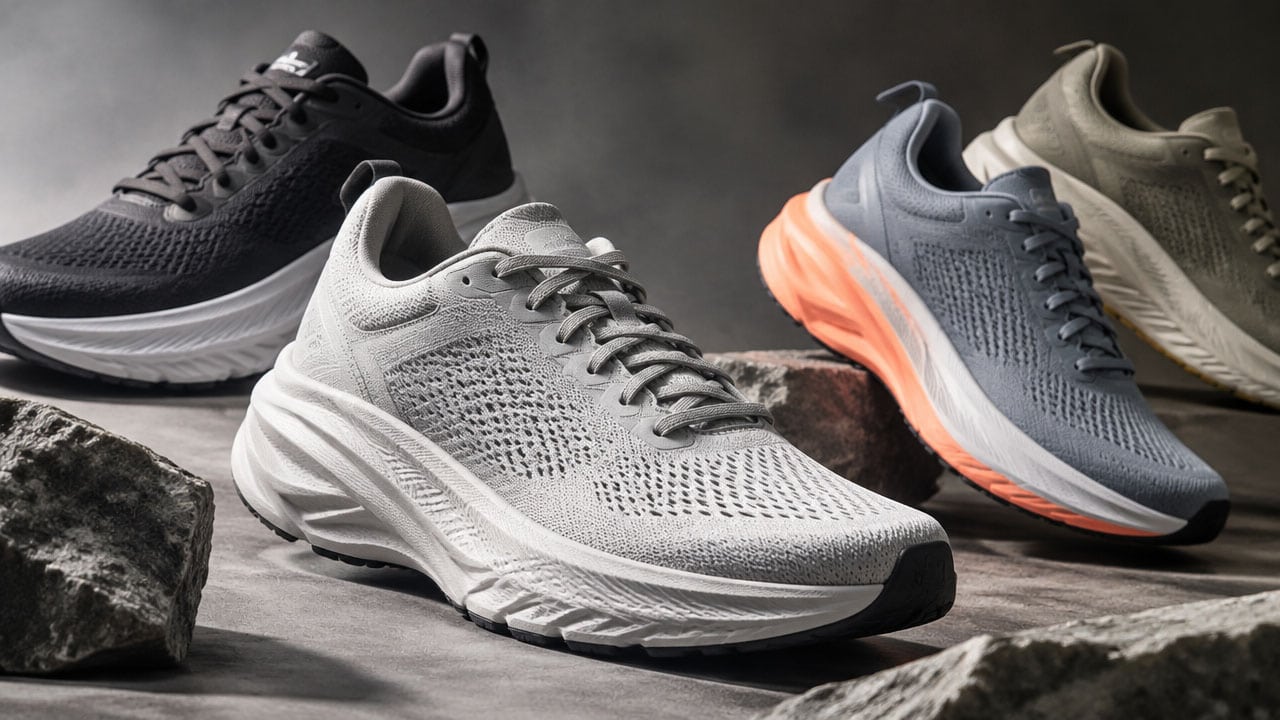

Our pick for most runners is the Brooks Ghost 18, at $150. Brooks says most of its products are made without animal-derived ingredients, dyes and glues included, and it names the exceptions. Mizuno, Newton and Veja’s Condor 3 also pass on the maker’s word. Read the full name on the box, though: one Ghost Max is cow leather.
The Ghost Max 4 is a road running shoe at $165 on Brooks’ own site, and nothing about it is on Brooks’ list of products with animal materials. The Ghost Max Slip Resistant sits in the same family at $175, and its product page sells “easy-to-clean full-grain leather” as a feature. Brooks’ own list says it contains full-grain cow leather, and so does a Ghost Max L. Two words of model name separate a vegan shoe from a leather one, and Brooks shows both on the same Ghost page of its site.
That is the pattern for this whole category. Leather and suede are the parts you can catch yourself, if the tag admits to them. The glue that holds the upper to the sole and the dye in the mesh are the parts you cannot, which is why the useful question for every shoe below is what exactly the maker has put in writing. The mesh itself is usually polyester, and our piece on whether polyester counts as vegan covers that layer.
The seven running shoes, and who should skip each
Prices are from each maker’s US store when we read it in October 2026, and they move. None of this says how a shoe runs. Fit is a separate decision, made at a running shop or against a returns policy you have actually read.
Brooks Ghost 18
The Ghost 18 is our pick because Brooks has written down more than anyone else here. Its support page says most Brooks products “are made without animal-derived ingredients and are not tested on animals, including components like dyes and glues”, then lists the six products that do contain leather or suede. The Ghost 18 is not among them. It costs $150 on Brooks’ US site, which also says 55.3% of the upper is recycled material and offers 90-day free returns.
The flaw is that the claim is Brooks’ own, with no outside scheme named in it, and that “most” does a lot of work. The shoe is vegan because it is absent from a list, so the list is the thing to check again on the day you buy. If a third-party mark is your minimum, this is not your shoe.
Brooks Ghost Max 4
Same reasoning, more foam. Brooks describes the Ghost Max 4 as “like the Ghost with even more cushioning” and lists it for daily runs, long runs and walking, with a 6 mm drop and a recycled share of 57.6% in the upper. It is $165, and it is not on the exception list.
Its downside is the name. Brooks’ exception list includes the Ghost Max L and the Ghost Max Slip Resistant, both with full-grain cow leather, so “Ghost Max” on a receipt or a resale listing proves nothing. Skip it if you are buying second-hand from a listing that gives only the family name.
Brooks Ghost Max Slip Resistant
Do not buy this one. Brooks lists it as containing full-grain cow leather, and the product page, filed under walking shoes, names “easy-to-clean full-grain leather” among its features, at $175. Brooks deserves credit for saying so plainly on both pages. It is still a leather shoe, and if you work on your feet and want the Ghost Max cushioning, the Ghost Max 4 above is the version without the cow.
Mizuno Wave Rider 30
Mizuno makes the broadest claim of any brand here. Its European FAQ answers “Do you have vegan shoes?” with “our entire running footwear range is now 100% vegan friendly”, and says customers can pick any running shoe “with certainty that the products do not contain any form of animal-derived materials”. So you do not have to go model by model. The Wave Rider 30 is $150 on Mizuno’s US store, and the Wave Rider 29 was on sale at $99 when we read it.
The catch is geography. That statement lives on Mizuno’s European site, and the US product page for the Wave Rider 30 does not use the word vegan anywhere we could find. The FAQ also says “materials” and never names glue. If you want the claim from the company that actually sells you the shoe, email Mizuno USA and ask whether the European statement covers US stock.
Newton Gravity 14
Newton has the oldest claim on this list. It says that since the company started in 2007, every pair “has been made with certified vegan materials”, meaning “no leathers, suedes or animal byproduct adhesives in our shoes”, and that each pair contains seven recycled water bottles. It names adhesives, which Mizuno and Veja do not. The Gravity 14 is $185 on Newton’s store, and the women’s Gravity 13 was marked down to $92 from $185 when we read it.
The statement never says who did the certifying, and “certified vegan materials” is a claim about the inputs rather than the finished shoe. At $185 the Gravity 14 is also the second most expensive shoe here. If the discounted Gravity 13 fits, the 2007 date covers it too, which makes it the cheapest way into a shoe whose maker has put the glue in writing. Skip Newton if you need a named certifier before you pay.
Veja Condor 3 Advanced
Veja publishes the fullest materials list of any shoe here: an engineered-mesh upper of 100% recycled polyester, TPU panels, a bio-based EVA insole and plate with sugarcane in both, a midsole of Amazonian rubber and bio-based EVA, an outsole that is 25% Amazonian rubber, and recycled polyester lining and laces, made in Brazil. The Condor 3 Advanced appears in Veja’s vegan collection for adults. It weighs 9.7 oz with an 8 mm drop and costs $210, the most on this list.
The vegan word sits on the collection page, not in the product details, and the long materials list says nothing about adhesive. Watch the rest of Veja’s running section too. The Rio Branco II, sold under retro running at $170, lists suede and leather panels, so a Veja runner is vegan only if it is in that collection. If $210 is why you were hesitating, the Ghost 18 rests on a stronger statement for $60 less, by our arithmetic.
Allbirds Dasher NZ
This is the second shoe not to buy, and it is the one that would fool me. The Dasher NZ has a “breathable tree knit upper” and SweetFoam cushioning made from sugarcane, so everything on the outside reads plant. The same feature list includes a “wool-blend lining for softness, socks optional”. Allbirds sells it at $140 and lists jogging among its uses, next to walking, and nothing on the page calls it vegan. A tree shoe with sheep inside it is not one for this list.
How the seven compare
| Shoe | Price when read | What the vegan claim rests on | Skip it if |
|---|---|---|---|
| Brooks Ghost 18 | $150 | Brooks: no animal-derived ingredients, dyes or glues in most products; not on its exception list | You want a third-party mark |
| Brooks Ghost Max 4 | $165 | Same Brooks statement and list | You are buying from a listing that says only “Ghost Max” |
| Brooks Ghost Max Slip Resistant | $175 | Not vegan: full-grain cow leather, per Brooks | Always |
| Mizuno Wave Rider 30 | $150; Wave Rider 29 $99 on sale | Mizuno’s European FAQ: whole running range free of animal-derived materials | You want the claim from Mizuno’s US arm |
| Newton Gravity 14 | $185; women’s Gravity 13 $92 on sale | Newton: certified vegan materials since 2007, no animal adhesives | You need the certifier’s name |
| Veja Condor 3 Advanced | $210 | Listed in Veja’s vegan collection | Price is your limit |
| Allbirds Dasher NZ | $140 | Not vegan: wool-blend lining | Always |
Two brands are missing on purpose. Eurofins Chem-MAP verified the Hylo Run/2 as free from animal derivatives in April 2022, using PCR analysis for DNA, FTIR analysis and microscopy, the most thorough check of any running shoe we found. Hylo’s store now sells the Axis and the Impact 2, priced in pounds when we read it, and the Run/2 is not among them. Bahé describes “our vegan shoes” as made from recycled and plant-based materials, with an outsole of 65% natural rubber, but it sells from the UK in pounds as well, so we left it off a US list.
Where a vegan running shoe can still go wrong
Leather and suede turn up on running shoes as overlays and heel tabs, and Brooks’ own exception list shows they can sit in a family whose other members are fine. Synthetic suede is the usual replacement, and our look at how long vegan leather lasts covers what to expect from it.
The parts no tag lists are the glue and the dye. Labs can test both. Bureau Veritas says it verifies “the absence of glue and adhesives of animal origin” by HPLC-MS/MS, checks dyes by mass spectrometry, identifies polymers by FTIR, and can check for cross-contamination during manufacturing. None of the five shoes that pass here cites a lab result like that. Brooks and Newton at least name the glue in their statements.
A logo on the box is not the same thing as a lab test either. PETA’s FAQ for its vegan approval says “Testing is not a requirement for the approval process, but we do not discourage it”, and that the application is a questionnaire plus statements of assurance from the company and its suppliers, used to decide whether a product is made with vegan materials. PETA does not publish what was submitted, and the annual fee runs from $250 to $3,000 depending on company revenue. The Vegan Society trademark sets a wider rule on paper: no animal product, by-product or derivative in the product’s manufacture, development or ingredients, and no animal testing by the company or on its behalf.
Our line for this list is that a lab result outranks a written maker statement that names glue, which outranks a statement that only says materials, which outranks a collection page. That ranking measures how much you are taking on trust. It says nothing about any brand’s honesty.
How to check a running shoe yourself
Start with the materials tag, because suede and leather are the one problem you can catch on your own. The Allbirds lining above shows why it has to be the whole tag and not just the upper.
Then match the full model name against the maker’s own statement. With Brooks that means the exception list, word for word, because Ghost Max on its own covers both a vegan shoe and a leather one.
Ask about adhesives by name when a brand has not answered already. “All our materials are vegan” has not answered the glue question unless it says glue.
Check again when a shoe gets a new version number, since every statement here describes the range on the day we read it.
If the synthetic overlays on your next pair are what you are weighing up, our guide to what vegan leather is made of is where to go next.
Sources
- Brooks Running, vegan products: animal-derived dyes and glues, exception list
- Brooks Ghost 18, price, recycled upper, 90-day returns
- Brooks Ghost Max 4, price, use, drop, recycled upper
- Brooks Ghost Max Slip Resistant, price and full-grain leather
- Brooks Ghost series page, Ghost Max 4 and Ghost Max Slip Resistant side by side
- Mizuno Europe FAQ: entire running footwear range vegan friendly
- Mizuno USA neutral running shoes, Wave Rider 30 and 29 prices
- Mizuno USA Wave Rider 30 product page
- Newton Running, certified vegan materials since 2007, no animal byproduct adhesives
- Newton Gravity 14 price
- Newton women’s Gravity 13, sale price
- Veja Condor 3 Advanced, materials, weight, drop, price
- Veja vegan collection, adults
- Veja Rio Branco II, suede and leather panels
- Allbirds Dasher NZ, tree knit upper and wool-blend lining
- Eurofins Chem-MAP, Hylo Run/2 vegan verification and test methods
- Hylo Athletics store, current running shoes
- Bahé, sustainability: vegan shoes and natural rubber outsole
- Bureau Veritas, vegan product testing for clothing and footwear
- PETA-Approved Vegan FAQ: testing, application, confidentiality, fee
- Vegan Society trademark standards