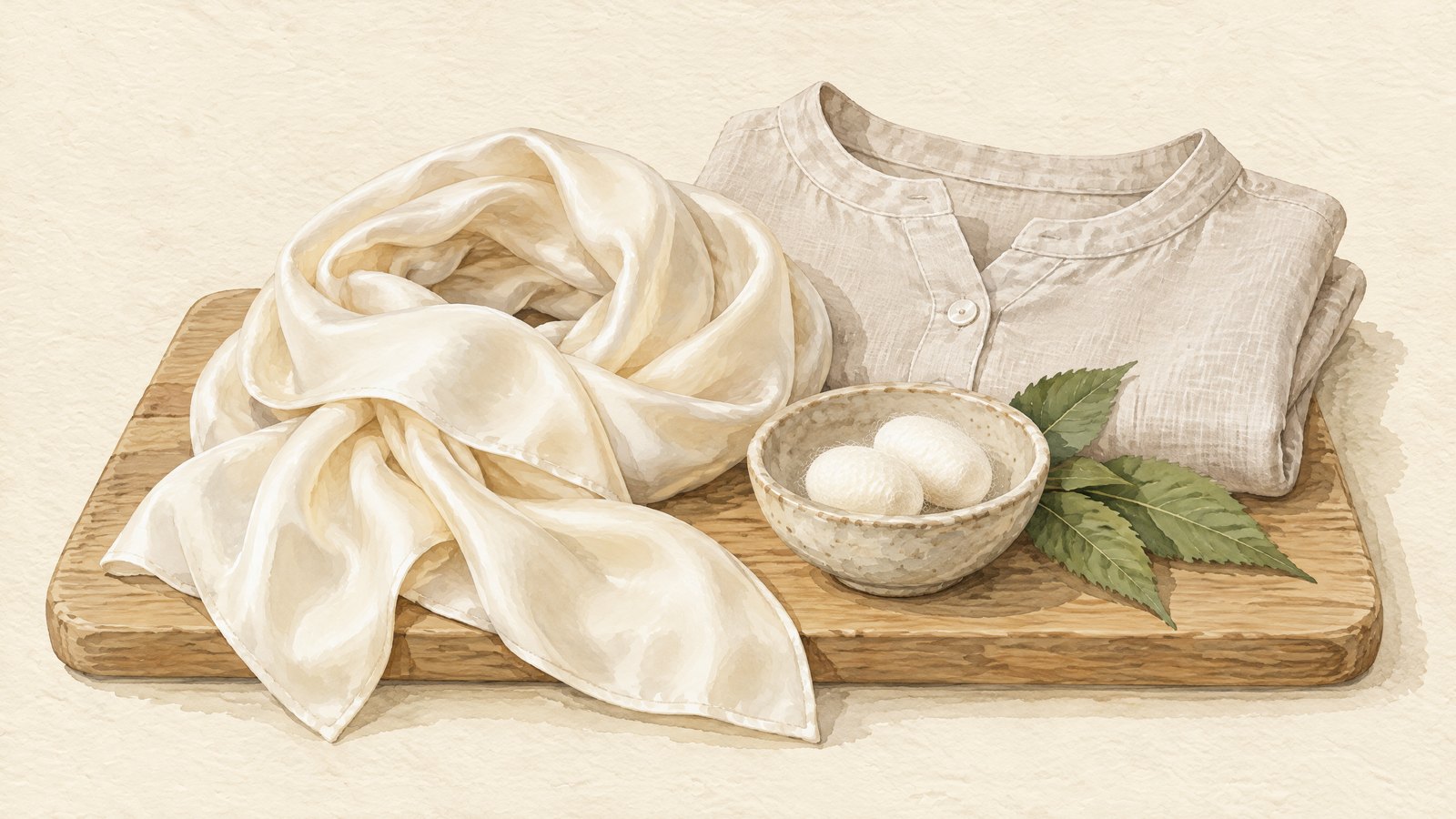

No, silk is not vegan, and peace silk does not change that. Silk is spun by silkworms, and conventional producers dry or steam the cocoons to kill the pupa before the moth can break out. It can also hide, because a lining used only for structure does not have to appear on a US fiber label.
That last part comes from the FTC’s own guide to textile labels. If a lining, interlining, filling or padding is there only for structural purposes, there is no requirement to disclose its fiber; only linings and fillings added for warmth must be listed. The Vegan Society, which certifies clothing under its Vegan Trademark, says silk and wool are often used as lining or padding inside handbags and jackets. So a jacket’s label can name the shell and stay quiet about what is sewn inside it. I have stood in a shop reading the outer fabric of a coat, feeling thorough, and didn’t once turn it inside out. A bag with a vegan leather outer can be lined in anything, so the outside settles nothing on its own.
Why silk isn’t vegan
The plainest account of the kill is in the industry’s own manual. The FAO’s silk reeling manual names the hazard: a newly emergent moth pierces the shell, “rendering the cocoon useless for conversion to raw silk”. Drying is the fix, and the manual says drying kills the pupa; with steam, the pupae are dead within 30 minutes.
The Vegan Society’s trademark standards say the development or manufacture of a product and its ingredients must not involve the use of any animal product, by-product or derivative. Silk is an animal product before anyone decides how to harvest it, which is why the harvest method doesn’t move it out of that category.
Does peace silk make it vegan?
Peace silk, also sold as ahimsa silk, is silk from cocoons the moth is allowed to leave. The Ethical Silk Company says its own mulberry silk is “often referred to as peace silk or Ahimsa” and that its producer’s process lets the silkworm complete its lifecycle, maturing into a moth.
People who buy it argue that if the moth leaves first, the harvest kills nothing, and an empty cocoon is closer to something an animal has finished with than to a farmed product. That is a real position, and on welfare alone it is a better harvest than steaming.
Vegans who refuse it start from the definition. The Vegan Society describes veganism as seeking to exclude, as far as possible and practicable, all forms of exploitation of and cruelty to animals for food, clothing or any other purpose. An insect bred and fed for its fiber is being used whether or not it dies at harvest. Nothing we read for this article, from the FTC’s labeling guide to the Vegan Society’s standards, defines peace silk, so the word means whatever the seller means by it.
The FAO manual treats a pierced cocoon as useless for raw silk, and the Ethical Silk Company’s pages do not say how its cocoons become a 19 momme pillowcase. The page leaves that open, and a pillowcase tag can’t answer it either.
Our line at veganpots.com is that peace silk is not vegan. It is still an animal fiber, the term has no definition behind it, and a garment tag gives you no way to check the harvest.
Seven silk and silk-look products, checked on the maker’s page
| Product | Fiber, per the maker | Vegan? | The catch |
|---|---|---|---|
| Blissy Pillowcase | 100% mulberry silk, 22 momme | No | Silk is the selling point |
| The Ethical Silk Company Mulberry Silk Pillowcase | 100% mulberry silk, 19 momme, sold as peace silk | No | Cruelty-free is not vegan |
| Kitsch Satin Pillowcase | Satin; the product page does not name the fiber | Yes, per Kitsch | Hand wash cold, air dry |
| ettitude Luxe Bamboo Pillowcase Set (PLNTsilk) | 90% CleanBamboo lyocell, 10% bamboo biochar | Nothing animal listed | $100 to $130 a set |
| ettitude Signature Bamboo Pillowcase Set | 100% CleanBamboo lyocell | Nothing animal listed | Not sold as PLNTsilk |
| TENCEL Lyocell (Lenzing) | Regenerated cellulose from wood | Yes, as a fiber | A fiber, not a garment |
| Bemberg cupro (Asahi Kasei) | Regenerated cellulose from cotton linter | Yes, as a fiber | A fiber, not a garment |
Blissy Pillowcase
Blissy lists its pillowcase as 100% pure mulberry silk, 22 momme, grade 6A. It also puts “Silk, not satin” near the top of its pitch, which at least saves you reading further. The silk is the whole point of the product, so there is no version of it for you if you are vegan. Skip it.
The Ethical Silk Company Mulberry Silk Pillowcase
This one is harder to put down, because every word on the page is kind. The pillowcase is 100% mulberry silk at 19 momme, and the company says it is made by artisan weavers “using cruelty-free peace silk”. The company is in the UK but sells to the US, and its site says US customers are not charged additional duty. Cruelty-free on this page describes how the moth was treated, which is a claim about welfare and has nothing to say about whether the fiber is vegan. It isn’t. If you are vegan, don’t buy it, however gentle the copy reads.
Kitsch Satin Pillowcase
Kitsch says its satin pillowcases are “Vegan and cruelty-free”, which is the sentence you came for. What the product page does not give you is the fiber: it lists a 600 thread count and an OEKO-TEX certification, and stops there. Satin is a weave, so the sewn-in label is where you find out what it is woven from. On 22 October 2026, Kitsch’s US site listed the standard/queen size at $29. The catch is the laundry. Kitsch says to hand wash it in cold water and air dry, so if your pillowcases go in the machine with everything else, this is not your pillowcase.
ettitude Luxe Bamboo Pillowcase Set
This is the set ettitude sells in its PLNTsilk fabric, and it is our pick for anyone who wanted a silk pillowcase in the first place. The fiber line reads 90% CleanBamboo lyocell and 10% bamboo biochar, woven in Peru. Nothing from an animal is listed, though the page never uses the word vegan. The flaw is price. ettitude’s US site listed it at $100 to $130 a set on 22 October 2026. Leave the water-saving percentages on the same page out of the decision; they are the seller’s figures about its own process.
ettitude Signature Bamboo Pillowcase Set
Same brand, plainer fabric. It is 100% CleanBamboo lyocell in a sateen weave that ettitude says feels smooth like silk, at $70 to $80 a set on 22 October 2026. It is not sold under the PLNTsilk name, and the fiber line differs from the Luxe set by the biochar. If the price of the Luxe set is the problem, compare this one first.
TENCEL Lyocell
For clothing rather than bedding, lyocell is the fiber to look for. Lenzing says TENCEL Lyocell fibers are regenerated cellulosic fibers made from wood, in a closed loop where more than 99.8% of the solvent is recovered and fed back in. The weakness is that TENCEL is a fiber brand, not a garment. A blouse can be part lyocell and part something else, and the FTC requires every fiber to be named with its percentage by weight, so read the whole line, not the brand.
Bemberg cupro
Cupro is the other silky plant fiber you will meet on a label. Asahi Kasei describes Bemberg as its brand of cupro, a regenerated cellulose fiber made from 100% cotton linter, the short downy fiber around cotton seeds, which it buys from partner oil mills. You won’t find a Bemberg product on a shelf. Asahi Kasei sells the fiber, so look for the word cupro on the fiber line, with Bemberg beside it at most.
Which to buy
For a pillowcase, our pick is the ettitude Luxe set if the budget stretches, and the Kitsch pillowcase if it doesn’t and you don’t mind hand washing. For clothing, look for lyocell or cupro on the fiber line, and read the lining too. Don’t buy either silk pillowcase above if you are vegan, peace silk included.
How to check a label yourself
Under the FTC’s rules, natural and man-made fibers both have to be identified by their generic names, with the percentage by weight of each, in order of predominance. So silk has to say silk. There is no rounding up, either: the FTC’s own example is a blouse that is 97% silk and 3% polyester, which cannot be labeled 100% silk. A fiber trademark may appear on the label only next to the generic fiber name, so TENCEL on its own is incomplete and lyocell is the word to look for.
Then the gaps. Linings and paddings used only for structure don’t have to be disclosed, and various forms of trim are excluded from the labeling requirements altogether. Turn the item inside out and read whatever sits against the lining side, piping included. If you can’t tell what it is, ask the seller before you buy.
Peace and ahimsa next to the word silk describe a harvest, not a material, and cruelty-free on a silk tag works the same way. The mark that settles it is the Vegan Trademark, which can be applied only to a product that fully complies with the Vegan Society’s certification standards. If a brand claims registration and you can’t find the mark, the standards list a fashion contact at [email protected].
If the tag on a satin says polyester, our polyester verdict covers what to check in the blend. If it says silk, peace or otherwise, put it back.
Sources
- FAO, Silk reeling and testing manual, chapter 4: cocoon drying, storage and sorting
- Federal Trade Commission, Threading your way through the labeling requirements under the Textile and Wool Acts
- The Vegan Society, 30 years of making vegan fashionable with the Vegan Trademark (2020)
- The Vegan Society, Vegan Trademark certification standards
- The Ethical Silk Company, about its mulberry silk
- The Ethical Silk Company, Mulberry Silk Pillowcase
- Blissy, Pillowcase, white, queen
- Kitsch, Satin Pillowcase in Ivory
- Kitsch, 7 reasons you’ll love our satin pillowcase
- ettitude, Luxe Bamboo Pillowcase Set
- ettitude, Signature Bamboo Pillowcase Set
- TENCEL, fibers: TENCEL Lyocell and Modal
- Asahi Kasei, What is Bemberg?
- Asahi Kasei, Bemberg flyer (PDF): cotton linter from partner oil mills