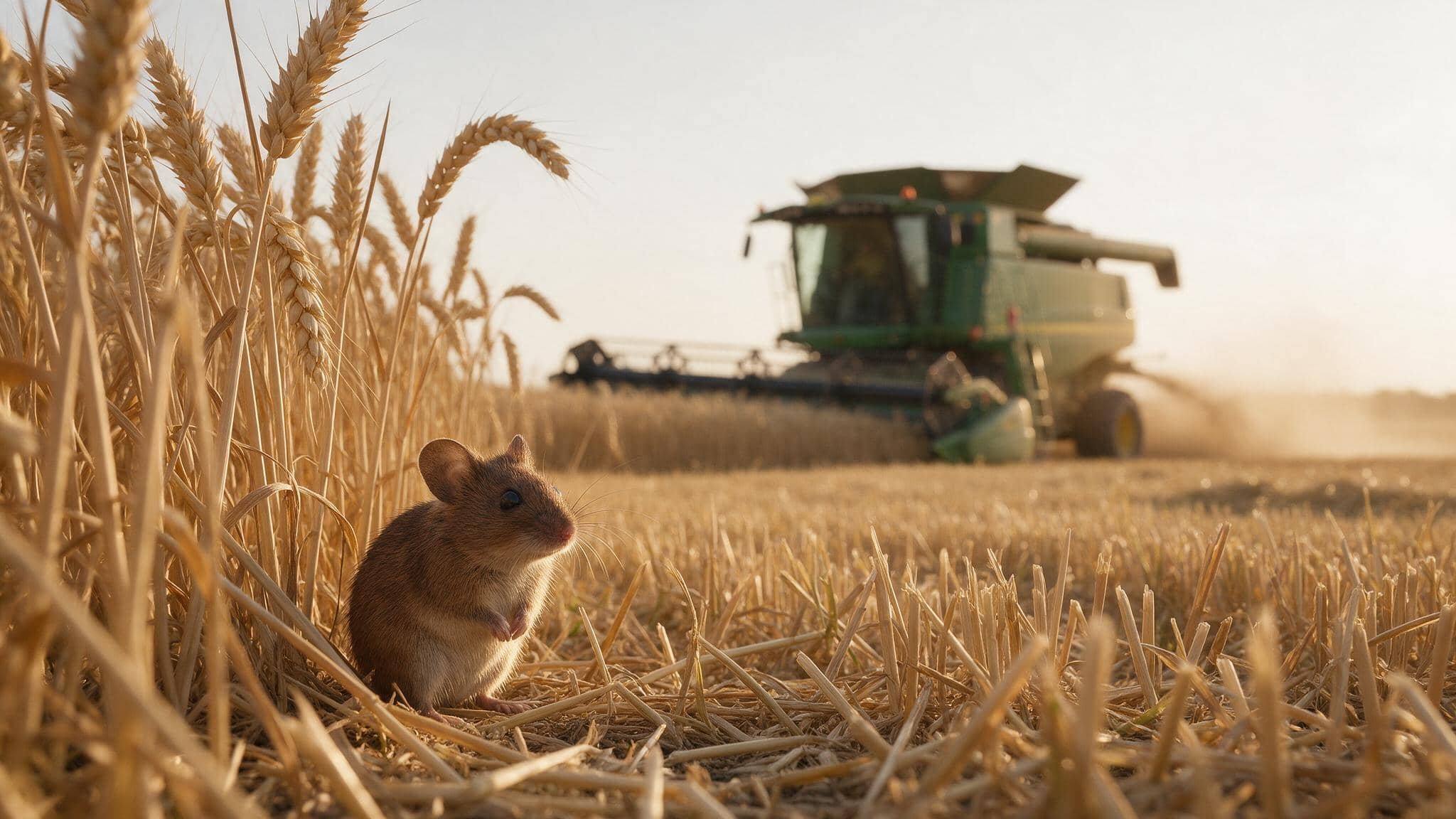

No, crop deaths don’t make veganism pointless. Take the figures from the paper that made the argument respectable, count the dead per person fed instead of per country, and a vegan diet comes out at about 0.3 field animals a year against 1.5 for the grass-fed omnivore that paper recommended.
I hear the crop-deaths line at a fair number of dinner tables, usually as the closing move, the conversational version of tipping the board over. For years I answered it with a shrug and a mouthful of roast potato, which convinced nobody, me included. It deserves better, and so does the person asking. Most of what I’ve learned about answering criticism without losing the room comes down to taking the other side at its strongest, so that is where this starts.
The case for the steak, at full strength
In 2003 Steven Davis published a paper in the Journal of Agricultural and Environmental Ethics called “The least harm principle may require that humans consume a diet containing large herbivores, not a vegan diet”. The title is the whole argument.
He started from Tom Regan. Told that vegan agriculture kills animals in the fields too, Regan answered that a vegan or vegetarian diet still causes the least total harm, and Davis named that reply the Least Harm Principle. Then he turned it around. In his model a hectare of crops kills about 15 field animals and a hectare of ruminant pasture about 7.5, so trading some cropland for grazing cattle kills fewer animals overall: 1.8 billion for an all-vegan US by his totals, against 1.35 billion for his mixed system. His conclusion was that we may be morally obligated to eat both plants and ruminant products, cattle in particular.
That is a serious argument, and it is aimed at vegans on their own terms. If what matters is how many animals die, then how the food is grown matters more than what the diet is called. A vegan who claims to care about harm and refuses to run the sum is protecting an identity.
Counted per person, the sum flips
Gaverick Matheny answered in the same journal the same year, and he went after the arithmetic rather than the ethics. Davis had assumed that a crops-only system and a crops-plus-pasture system on the same total land would feed the same number of people. They wouldn’t, because crops and grazing produce different amounts of food from a hectare. So Matheny counted the animals killed to feed equal populations, at 20 kg of protein per adult per year, and got 0.3 wild animals a year for a vegan, 0.39 for a lacto-vegetarian and 1.5 for a Davis-style omnivore. He kept Davis’s measure, body counts and nothing else, and still landed on the plant side.
The feed numbers lean the same way. FAO counts about 35 percent of the world’s cereals and 24 percent of its pulses going to animal feed in 2023, against 45 percent of cereals eaten directly as food. Whatever dies in the fields that grow that feed is already on the meat side of the ledger, which is awkward for an argument that treats the harvest as the vegan’s problem alone. A 2018 study in Science found that meat, aquaculture, eggs and dairy use around 83 percent of the world’s farmland while providing 37 percent of our protein and 18 percent of our calories.
All of these numbers sit on thin evidence. Bob Fischer and Andy Lamey, writing in the same ethics journal in 2018, open their paper with this: “We know that animals are harmed in plant production. Unfortunately, though, we know very little about the scale of the problem.” Davis’s 15 and 7.5 are only as good as the field counts behind them, and Matheny’s per-person figures start from Davis’s per-hectare ones. A shakier toll from crops weakens the grazing case, and it also shrinks any tidy margin a vegan might want to claim. Nobody at the table gets to wave a hard number.
Does an accidental death count the same?
Under all the counting sits a question no count settles, which is whether an animal killed by a combine weighs the same as one killed on purpose. Some vegans say it doesn’t. A slaughterhouse exists to kill, and a harvest kills as a side effect the farmer would happily avoid. Others find that too comfortable, because a death you can foresee every single year and accept anyway is hard to call an accident. It is the same kind of line-drawing that runs through the argument over oysters, where the fight is over what counts.
Our line at Vegan Pots is that field deaths are a real cost vegans should own, and a poor argument for eating animals. On intention we side with the second camp. Leaning on intention lets you stop counting, and counting is exactly where the case for plants holds up. Taking crop deaths seriously means caring how the food on your plate was farmed. Handing the problem to a cow doesn’t get you far when more than a third of the world’s cereals already go to animals.
The part I am least sure about is the version Davis was gesturing at underneath his model, a little meat from animals grazed on land that could grow nothing people eat. Matheny’s correction answers the system Davis actually built. Whether it answers every hillside smallholding, I can’t tell you, because none of the sources here measure one.
For the wider question of what going vegan changes for animals at all, read whether veganism really helps animals.
Sources
- Matheny, “Least harm: a defense of vegetarianism from Steven Davis’s omnivorous proposal”, Journal of Agricultural and Environmental Ethics 16 (2003), full text
- Davis, “The least harm principle may require that humans consume a diet containing large herbivores, not a vegan diet”, Journal of Agricultural and Environmental Ethics 16 (2003), abstract
- FAO, food balance sheets 2010 to 2023: share of cereals and pulses used as feed and food
- Poore and Nemecek, “Reducing food’s environmental impacts through producers and consumers”, Science (2018)
- Fischer and Lamey, “Field deaths in plant agriculture”, Journal of Agricultural and Environmental Ethics 31 (2018)