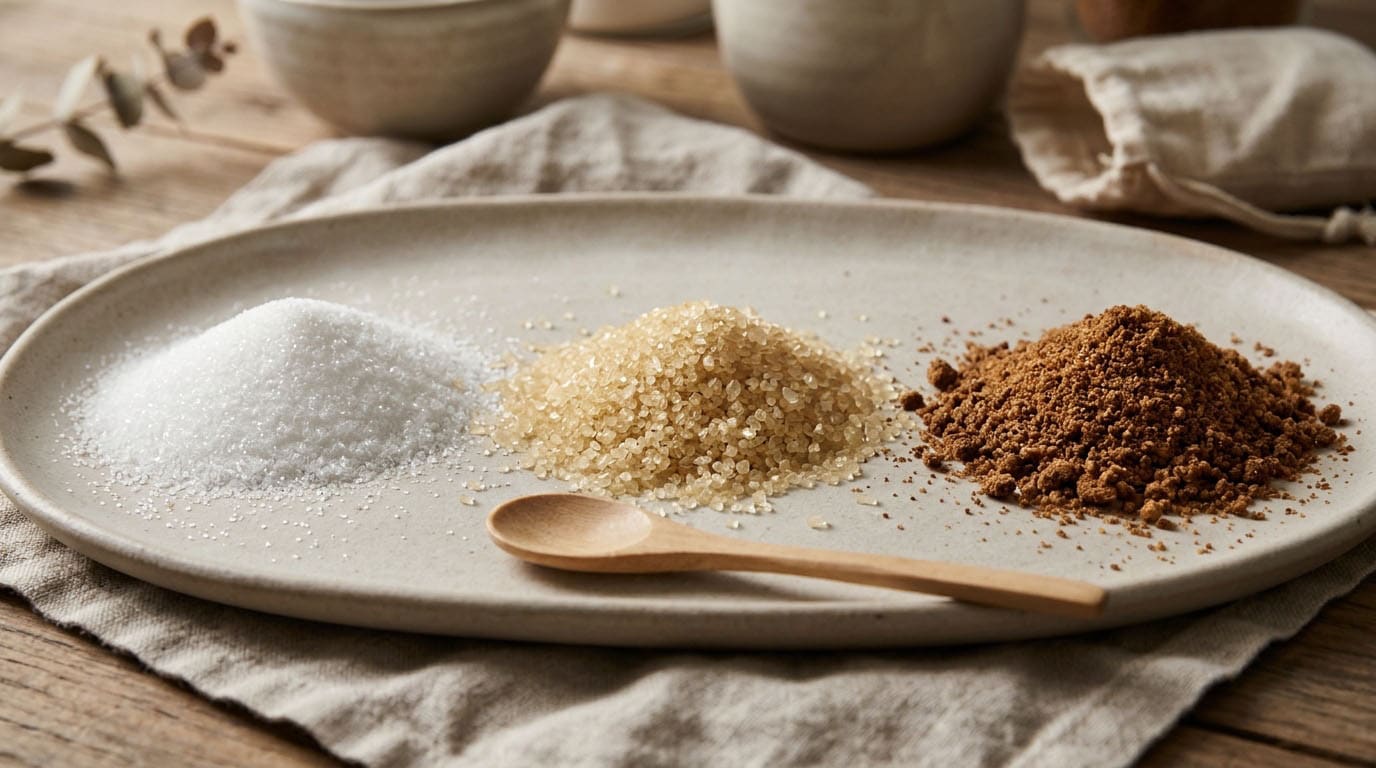

Sugar is vegan unless it is cane sugar filtered through bone char, a charcoal made from cattle bones. Beet, USDA organic and Certified Vegan sugars skip it. On a plain bag of Domino or C&H, read the first character of the lot code; their refiner says 1, 4 and 6 mean no bone char.
ASR Group, which makes Domino, C&H and Florida Crystals, publishes a coding sheet that turns the first character of a lot into a place, the plant where the bag was packed. 1 is Yonkers, 4 Baltimore, 5 Chalmette, 6 South Bay (and two other sites) and 7 Crockett. In 2019 ASR told the Vegetarian Resource Group that it decolorizes with natural charcoal, its name for bone char, at Chalmette and Crockett but not at Baltimore or Yonkers, and that South Bay doesn’t use bone char either. Two years later its senior director of global corporate quality told the same group that a package whose lot number begins with 1, 4 or 6 is completely bone char-free.
The lot-code trick only works on a bag of sugar. For sugar inside a packaged food, our guide to reading a food label covers what to do with an ingredient list that says sugar and nothing more.
What bone char does, and which sugars never meet it
ASR describes natural charcoal as the step that removes color and impurities from the sugar liquor at Chalmette and Crockett, and its other refineries use an ion exchange resin or granular activated carbon made from coal or coconut husks instead. Imperial Sugar and Dixie Crystals both say they filter with activated carbon and use no bone char. ASR also says its refined sugar contains no actual impurity from the natural charcoal, so the argument is about how the sugar was made, not what is in it.
Whether that counts is a line vegans draw in different places. One side says the sugar contains no animal product, and the bones would exist whether a refinery bought them or not. The other says a refinery that buys bone char is still paying for a slaughter by-product, every time the filter is replaced. Vegan Action, which runs the Certified Vegan mark, rules out sugar filtered with bone char. This site draws the line in the same place, and every verdict below counts bone char as not vegan.
Beet sugar sidesteps the whole thing: the Vegetarian Resource Group reported in 2007 that bone char filtering is never used in beet sugar processing. Organic sugar is covered by law. The USDA organic rules allow activated charcoal in products labeled organic only from plant sources, and only as a filtering aid, and the VRG reported back in 2007 that certified USDA organic sugar cannot be filtered through bone char. ASR told the group the same of a certified organic sugar it sells. The lot rule ASR gave the VRG covers any package of Domino, C&H or Florida Crystals, so the same check works on their other sugars too. Coconut sugar and maple syrup come from other plants and get their own section further down.
8 sugars and what their makers say
Each verdict below rests on what the company itself says, on its site, on its package or in answers it gave the VRG. Where a page says nothing, we say that too.
| Sugar | Bone char? | Who says so |
|---|---|---|
| Domino Golden Sugar | Vegan certified, certifier not named | ASR Group |
| Domino Premium Pure Cane Granulated Sugar | Depends on the plant; lot 1, 4 or 6 is free | ASR Group, to the VRG |
| C&H Pure Cane Granulated Sugar | Only lot 1, 4 or 6 is vouched for; Crockett (7) uses bone char | ASR Group, to the VRG |
| Florida Crystals Raw Cane Sugar | Vegan certified, certifier not named | Florida Crystals |
| Imperial Sugar | No | Imperial Sugar |
| NOW Foods Beet Sugar | No | NOW Foods |
| Sugar In The Raw | No, Certified Vegan | In The Raw |
| Big Tree Farms Brown Coconut Sugar | Its method description has no filter step | Big Tree Farms |
Domino Golden Sugar
Our everyday pick, because it answers the question without making you read a code. ASR’s 2023 release calls Golden Sugar vegan and kosher certified, and Domino says it performs cup for cup in baking and dissolves in drinks just like white granulated sugar. It keeps a hint of molasses, which is where the golden color comes from. How Domino makes it is, in its own FAQ, “a proprietary process”, and that is the whole explanation. It is also new. Domino calls it the newest addition to the brand, and ASR says it launched in the Northeast in 2019 and only reached the Midwest in 2023. A small store may not have it yet.
Domino Premium Pure Cane Granulated Sugar
This is the bag the lot code matters for. ASR’s January 2019 letter says its Baltimore, South Bay and Yonkers refineries do not use bone char for decolorization, use no other animal ingredients or by-products, and so make products that qualify as vegan. ASR’s 2019 list has two plants still using natural charcoal: Chalmette, code 5, and Crockett, code 7.
Two caveats from the paperwork. ASR’s sheet calls the first character the packaging location, and gives 6 to South Bay and two other sites, so for 1, 4 and 6 alike we are relying on ASR’s word that the code means bone char-free. And none of the Domino FAQ pages we read mentions bone char, so the newest statement we found is the 2021 one. Don’t buy this one by habit. A lot that starts with anything other than 1, 4 or 6 goes back on the shelf.
C&H Pure Cane Granulated Sugar
C&H’s product page answers whether the sugar is gluten-free and what inspired its limited-edition packaging. Bone char doesn’t come up. ASR told the VRG in 2019 that C&H from California sells mostly in the West and in some of the Midwest, and that Crockett, code 7, uses natural charcoal. If bone char is your line, don’t buy C&H white sugar unless the lot starts with 1, 4 or 6.
Florida Crystals Raw Cane Sugar
Florida Crystals lists its raw cane sugar as vegan certified, along with non-GMO and kosher, made from sugarcane grown on its family-owned farms in the US. It belongs to the same ASR family as Domino and C&H, but with the vegan certification printed on the product page, the code can stay unread. The company says it can go in cup for cup wherever a recipe calls for white sugar, and that it has a tan or golden hue and a hint of molasses. In a pale sponge or a white buttercream, that tan will show.
Imperial Sugar
Imperial says it does not use bone char, that its refining uses activated carbon filters, and that all of its products are vegan. Dixie Crystals’ certifications page says the same in nearly the same words, with its own name in place of Imperial’s. Nobody has to decode a lot number to use it. The catch is whose word it is, since the page names the Orthodox Union as its kosher certifier and no vegan certifier at all. If you only buy behind a third-party vegan mark, this one doesn’t qualify.
NOW Foods Beet Sugar
NOW’s FAQ answers the question directly: no bone char or bone products are used in processing its beet sugar, and it is Non-GMO Project verified. The same FAQ describes bone char as something manufacturers once used and says it has since been replaced, while ASR’s own 2019 statement still names two cane refineries, Chalmette and Crockett, that use it. Buy NOW’s beet sugar on its own answer; don’t take its history lesson as a guarantee for the cane sugar next to it.
Sugar In The Raw
In The Raw says every product it makes is Certified Vegan by Vegan Action and that no animal by-products or bone char go into making them, with one exception: Honey In The Raw. That one, to be fair, warns you in the name. Sugar In The Raw itself is turbinado cane sugar, sourced from Colombia and Mauritius, and the bag calls it great for baking and sprinkling. We’d keep it for sprinkling, on a muffin top or a bowl of oatmeal, and pick a finer sugar for a smooth frosting.
Big Tree Farms Brown Coconut Sugar
One ingredient, coconut blossom nectar, and Big Tree Farms describes how it is made: the nectar is boiled down, cooled and worked by hand from a soft caramel into unrefined crystals. That description has no filter step in it. Big Tree sells it as a swap for brown sugar, with a moisture level close to brown cane sugar, and that moisture is the catch. The company’s page for its golden coconut sugar says recipes written for white sugar often fail when coconut sugar goes in, and that it vacuum-evaporates 95% of the water from the golden one to fix that. Use the brown one where a recipe wants brown sugar, and not in place of white.
Coconut sugar and maple syrup in a recipe
Plenty of pages warn that coconut sugar clumps in baking. Tara and I tried it ourselves and found that isn’t entirely true. Ground fine first, it baked well for us. Big Tree Farms says to swap its coconut sugars 1 to 1, the golden one for white sugar and the brown one for brown.
Maple syrup is sap boiled down, and its one vegan question is what the sugarmaker used to knock down the foam in the pan. Our roundup of vegan honey alternatives goes through that defoamer question and the extension advice on it, so it isn’t repeated here. When maple stands in for honey in my cooking, I use 3/4 cup of maple syrup for every cup of honey. Maple tastes sweeter to me, and that ratio gets the sweetness about level.
Put Domino Golden in the cart for everyday baking, and turn every white Domino or C&H bag over before it goes in. A lot starting with 1, 4 or 6 can stay, and anything else goes back. If the same cookie also needs the butter replaced, our guide to baking without butter has the ratios.
Sources
- The Vegetarian Resource Group, Is your sugar vegan? An update on sugar processing practices (2007)
- eCFR, 7 CFR 205.605, nonagricultural substances allowed in products labeled organic (paragraph b, activated charcoal)
- Vegan Action, Certified Vegan certification standards
- Domino Foods / ASR Group, North American lot coding scheme (January 2024, PDF)
- The Vegetarian Resource Group, Bone char-free vegan sugar update 2021: Domino, Florida Crystals and C&H (June 2021)
- The Vegetarian Resource Group, Sugar update 2019 part 1: ASR Group (C&H, Domino and Florida Crystals)
- Imperial Sugar, Certifications
- Dixie Crystals, Certifications
- ASR Group, Domino Sugar expands Golden Sugar footprint across Midwest (August 2023)
- Florida Crystals, Raw Cane Sugar (product page and FAQ)
- NOW Foods, Beet sugar FAQs
- In The Raw, FAQs
- Food Lion, Sugar In The Raw Turbinado Cane Sugar, 4 lb (package text)
- Big Tree Farms, Regenerative Organic Certified Brown Coconut Sugar
- Domino Sugar, Domino Sugar product FAQs
- Domino Sugar, Domino Golden Sugar FAQs
- Domino Foods / ASR Group, Vegan statement for the Baltimore, South Bay and Yonkers refineries (January 2019, PDF)
- C&H Sugar, Granulated Sugar (product page and FAQ)
- Big Tree Farms, Regenerative Organic Certified Golden Coconut Sugar