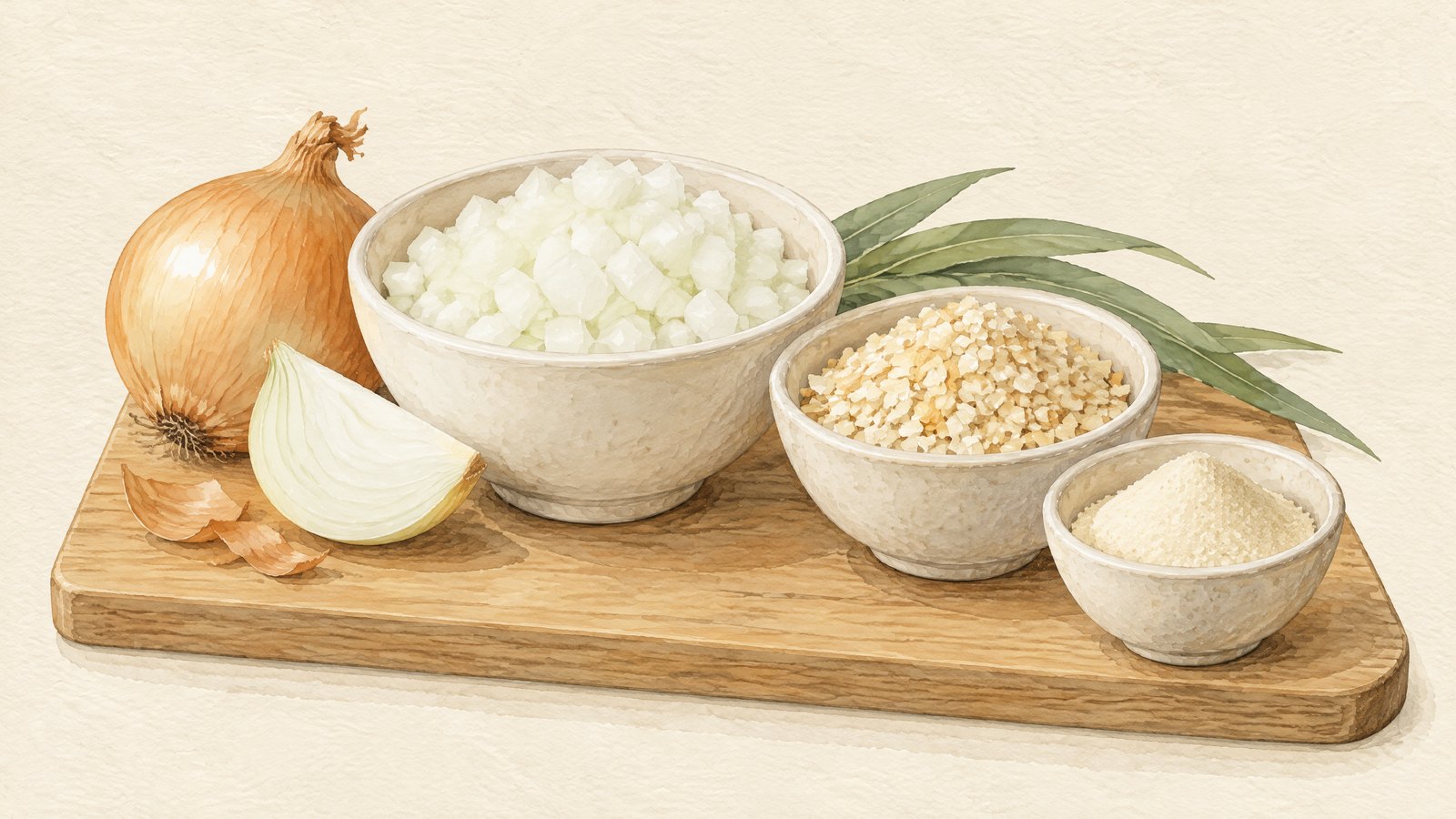

No. Onion powder is onion with the water taken out and ground fine, so it brings onion flavor without the pieces or the juice. Plain onion powder is vegan. The catch sits one shelf over: McCormick’s French onion dip mix lists buttermilk.
USDA puts raw onion at 89% water and onion powder at about 5%. Half a cup of chopped onion weighs 80 g, which leaves about 9 g of onion once the water is gone, or close to 4 teaspoons of powder at USDA’s 2.4 g a teaspoon (our arithmetic). No powder maker we read tells you to use that much. Spice Islands’ own figure works out to about 2.7 teaspoons for that half cup, Frontier Co-op’s to 1.5, and Morton & Bassett’s to just over half a teaspoon (our arithmetic). That is nearly five times between the top and the bottom, for the same pale powder. This site wasn’t helping, either. The three old onion powder posts this page replaces gave conflicting ratios, one of them contradicted itself, and none was sourced. How long a jar keeps is a separate question, answered in our guide to whether onion powder goes bad.
How much onion powder equals one onion?
Each maker’s figure, as printed on its own product page, with our conversion to half a cup of chopped onion. Where a maker says “one small onion” we used USDA’s 70 g small onion, and we treated minced and chopped fresh onion as the same measure.
| Product | What the maker says | Per 1/2 cup chopped onion (our arithmetic) |
|---|---|---|
| Spice Islands Onion Powder | 1 tsp for every 3 tbsp freshly minced onion | about 2.7 tsp |
| Frontier Co-op Onion Powder, White, Organic | 1 tsp for every 1/3 cup chopped onion; 1 tbsp for one fresh onion | 1.5 tsp |
| Morton & Bassett Onion Powder | 1/2 tsp equals one small onion | about 0.6 tsp |
| Frontier Co-op Onion Granules, White | 1 tbsp in place of one fresh onion | not given per cup |
| McCormick Chopped Onions | 2 tbsp for 1/2 cup chopped fresh onion | 2 tbsp |
| McCormick Minced Onions | 3 tbsp for 1/2 cup chopped fresh onion | 3 tbsp |
| USDA weights, as a ceiling | water removed, nothing else lost | about 3.8 tsp powder, or 1.8 tbsp dried flakes |
The USDA row is the most dried onion that half a cup of fresh can turn into, by weight. Every maker sits under it for powder, which suggests they are writing for flavor rather than weight, and they don’t agree on the flavor either. The dried pieces go the other way: both McCormick retail jars ask for more dried onion than half a cup of fresh can make, the minced one about 65% more by USDA’s flake weight (our arithmetic). McCormick also manages to disagree with itself. Its retail minced onion says 3 tablespoons for half a cup of fresh; its foodservice minced onion says 3 teaspoons for the same half cup, a third as much, for what both pages call minced onion.
So use the figure on the jar you own, because it was written for that powder, and treat it as the place to start. If your jar gives none, we would start at 1 teaspoon of powder per half cup of chopped onion and taste. Past about 4 teaspoons you are adding more dried onion than the fresh half cup ever held (our arithmetic from the USDA figures above).
What the powder does well, and where fresh onion wins
Powder is the right call wherever water or pieces would get in the way. The makers’ own suggestions line up: Frontier lists soups, potato dishes, casseroles and homemade seasoning blends for its powder, and mashed potatoes and stuffings for its granules. McCormick says to add its minced onion with the breadcrumbs in meatloaf and meatballs, and to try it in potato or pasta salad, dips, dressings and seasoning rubs.
Fresh onion wins wherever the onion is the point. Powder has nothing to soften in oil or brown at the edges, and no bite in a salad. If the recipe starts with a sliced onion cooking slowly in a pan, buy an onion.
If you are out of powder, granules are the closest swap, and Frontier gives the same 1 tablespoon per onion for its granules as for its organic powder. Minced or chopped dried onion works where small soft pieces are welcome. Onion salt and soup mixes also work, provided you account for the salt and garlic that come with them.
Nine onion jars and packets, label by label
We read each maker’s own product page in October 2026. Prices are the makers’ store prices on the day we read them, and every per-ounce figure is our arithmetic. Every McCormick jar here except the dip mix carries a vegan badge on its page; none of the other makers claims vegan. Every list printed here says onion and nothing else, except the onion salt and the two mixes, and three of the powders print no list at all.
Frontier Co-op Onion Powder, White, Organic
Our pick for powder. Frontier says it contains no additives or chemicals, although the page prints no ingredient list, and the 6.14 oz bag is $9.59, about $1.56 an ounce, the cheaper of the two powders here that show a price. It is also the only page that gives two kinds of ratio: 1 teaspoon per third of a cup of chopped onion, and 1 tablespoon for a whole onion. Those agree only if your onion makes a full cup chopped, which is more than USDA’s large onion (our arithmetic), so go by the per-cup figure. Its page also calls the powder up to 10 times stronger than raw onion, a figure we would not measure your soup by. Skip it if you use onion powder a pinch at a time: 6.14 oz is a lot of powder to keep dry once it is open.
Spice Islands Onion Powder
The powder figure closest to the USDA arithmetic comes from a page with no price and no ingredient list. Spice Islands says the powder is made with only premium white onions from the West Coast and gives its 1 teaspoon per 3 tablespoons of minced onion, but the page shows no ingredient list and no price, and tells you to check the label because formulation and packaging may change. Check it, then.
Morton & Bassett Onion Powder
Half a teaspoon for one small onion is the most confident sentence on any of these pages and the smallest amount. By USDA weights a small onion dries down to about 3.4 teaspoons of powder (our arithmetic), so the jar is asking for about a seventh of that. The 2.3 oz jar is $9.49, about $4.13 an ounce, and its page gives no ingredient list. Don’t follow its ratio in a recipe written for fresh onion unless you like your onion faint.
Frontier Co-op Onion Granules, White
The list says “White Onion.” and nothing else, at $5.19 for 2.29 oz, about $2.27 an ounce. Frontier describes the granules as easily dispersible in spice blends. Granules are a coarser grind than powder, so a dry rub or a shaker blend is where they earn the place. For a smooth sauce, buy the powder.
McCormick Chopped Onions
“Chopped Onions” is the whole list, and the 3 oz jar is listed at $5.49, about $1.83 an ounce, though it was out of stock on McCormick’s store when we read it. Its 2 tablespoons per half cup of fresh is the McCormick ratio nearest the USDA flake figure, and still a little over it (our arithmetic). Pick this over the minced jar below if you want pieces you can see in a stew. If you want the onion to disappear into the dish, this is the wrong jar.
McCormick Minced Onions
Same $5.49, a smaller 2 oz jar, so about $2.75 an ounce, and the list reads “Minced Onions”. The retail page wants 3 tablespoons for half a cup of fresh; the 17 oz foodservice jar, also all minced onion, wants 3 teaspoons. Start at the lower number. If you are choosing between this and the chopped jar on price, the chopped one lists an extra ounce for the same money, when McCormick has it in stock.
McCormick Onion Salt
The list is salt, onion, sodium silicoaluminate (to keep it free flowing) and extractives of onion, none of it animal, and the page carries a vegan badge. Labels list ingredients in descending order of predominance by weight, so salt is the biggest part of this jar, and onion second. It is $4.49 for 5.12 oz. Don’t swap it spoon for spoon for onion powder: if you use it, take the recipe’s salt out first.
Frontier Co-op Onion Soup & Dip Mix, Organic
Organic onion, sea salt, garlic, roasted garlic, toasted onion, black pepper, cane sugar, parsley, thyme and cream of tartar. Nothing animal on the list, $15.06 a pound. The dairy is in the directions instead: Frontier makes the dip with 3 tablespoons of mix and 2 cups of sour cream, and for soup uses 1 tablespoon in a cup of boiling water. Use a vegan sour cream and nothing animal goes into the bowl. As an onion powder stand-in it brings salt and garlic along, so it suits a burger mix better than a cream sauce.
McCormick Classic French Onion Dip & Seasoning Mix
The one to leave on the shelf. Onion, salt, buttermilk, yeast extract and chives, and the label adds “Contains: Milk”. McCormick also sells it as a seasoning for other dishes, which is how buttermilk ends up in something that was never a dip. It was out of stock on McCormick’s store when we read it, listed at $13.99 for six 1 oz packets. This one at least declares the milk; for foods where the animal part is harder to spot, see our list of 10 foods that aren’t vegan.
Reading onion on someone else’s label
Powdered or granulated onion can’t hide in the small print. FDA’s definition of a spice excludes foods such as onions, garlic and celery, and powdered or granulated onion has to be declared by its common or usual name, so it can’t be folded into “spice” or “natural flavor”. When a seasoning blend contains onion powder or granules, they are on the list by name. An onion extract is different: the same rule lets an extractive of a vegetable be declared as natural flavor, which makes McCormick’s onion salt, naming its extractives of onion, more forthcoming than it had to be. The order on the list tells you how much: ingredients run from most to least by weight, which is how the onion salt above gives itself away.
For a vegan, the onion is never the problem. Read past it to whatever else the mix contains and to the “Contains” line, which is where McCormick’s dip mix names milk. A jar whose list says onion and nothing else is the safe buy. The rest of the label is covered in our guide to checking whether a food is vegan.
Sources
- McCormick Classic French Onion Dip & Seasoning Mix, 1 oz (6-pack)
- USDA FoodData Central: onions, raw (water, cup, tablespoon and onion weights)
- USDA FoodData Central: spices, onion powder (water, weight per teaspoon)
- Spice Islands Onion Powder
- Frontier Co-op Onion Powder, White, Organic, 6.14 oz
- Morton & Bassett Onion Powder
- Frontier Co-op Onion Granules, White, 2.29 oz
- McCormick Chopped Onions, 3 oz
- McCormick Minced Onions, 2 oz
- USDA FoodData Central: onions, dehydrated flakes (water, weight per tablespoon)
- McCormick Culinary Minced Onion, 17.0 oz
- McCormick Onion Salt, 5.12 oz
- 21 CFR 101.4: ingredients listed in descending order of predominance by weight
- Frontier Co-op Onion Soup & Dip Mix, Organic, 1 lb
- 21 CFR 101.22: onions are not a spice, and powdered or granulated onion is declared by name