
Yes. House Foods says its tofu is pasteurized and safe to eat straight from the container, and Hodo says its products are fully cooked and lists microwaving as a way to heat them. With either, the microwave is warming tofu you could eat cold. Use a covered dish labeled for microwave use, and take leftovers to 165°F.
Thawing is where the instructions split. Mori-Nu’s tips page gives three ways to thaw its frozen silken tofu: the microwave at high for 2 to 3 minutes or at 40% power for about 4, an hour at room temperature, or overnight in the refrigerator. USDA’s food safety service says perishable food should never be thawed on the counter, and Mori-Nu’s own FAQ calls tofu highly perishable once it leaves the sealed box. The slices in those freezing directions have left the box long before they reach the counter, since the page has you cut them and wrap each one in plastic first. The same USDA sentence adds that perishable food must not sit at room temperature for more than two hours, but it rules out thawing on the counter whatever the time, so the hour is the one option on Mori-Nu’s page we’d skip. If what’s in the block matters more to you than how to heat it, our look at whether tofu counts as plant-based starts at the soybean.
Heat it in a dish, not the tub
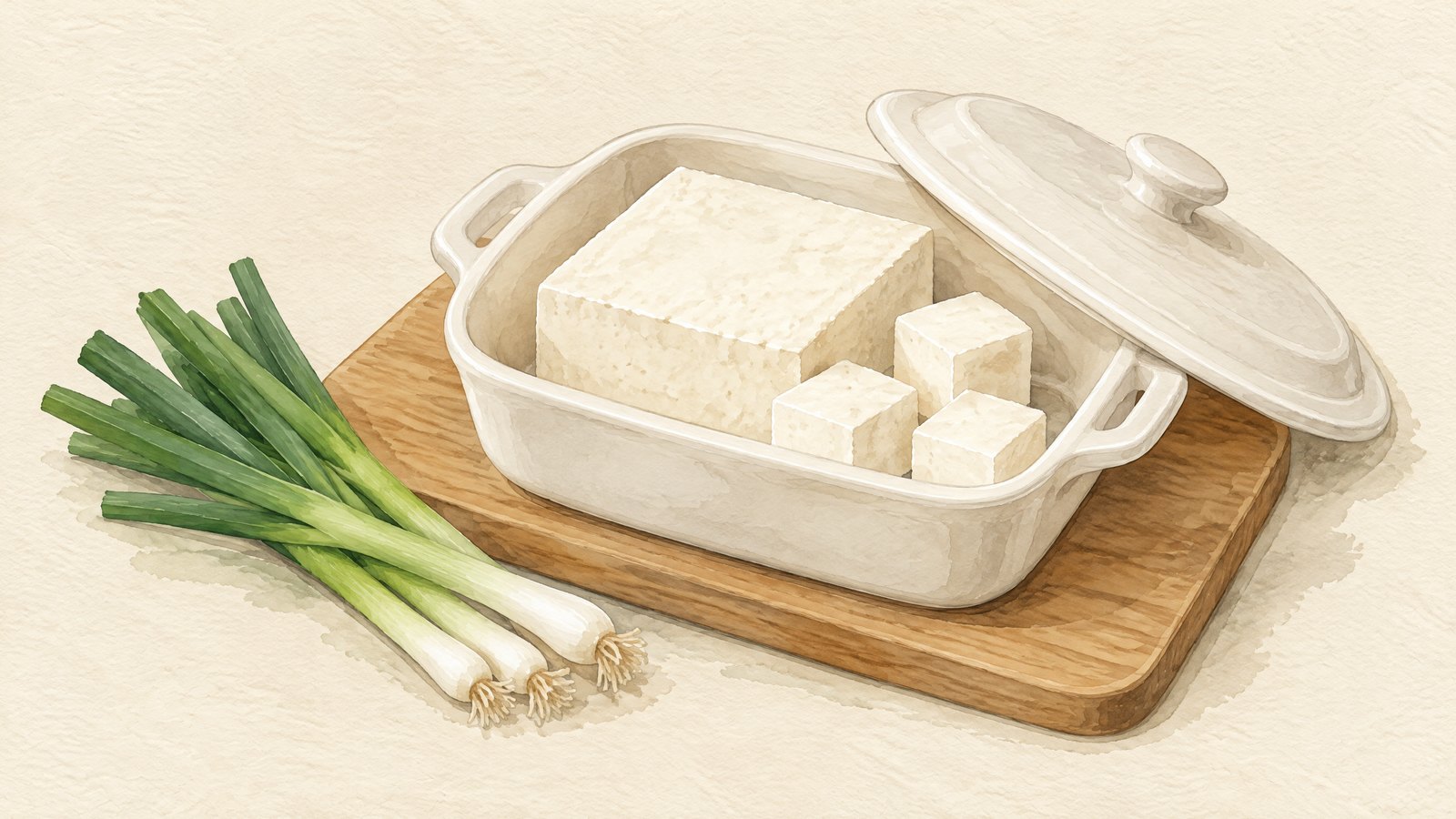
USDA’s list of containers that are not safe in the microwave opens with cold storage containers, naming margarine tubs and cottage cheese and yogurt cartons, because they are not approved for cooking and chemicals can migrate into food. A tofu tub isn’t named on that list. None of the maker pages we read says its tub can go in the microwave either. Lift the block out and drain it. Then put it in glass or ceramic, ideally marked for microwave use, which USDA says is how safe containers usually come; china with metallic paint or trim is on its not-safe list.
Cover the dish and leave the steam a way out. USDA says to vent the lid or the wrap and to keep plastic wrap from touching the food. Microwaves cook unevenly and leave cold spots where harmful bacteria can survive, so turn the pieces over top to bottom, and let the dish stand for at least 3 minutes after the oven stops, because the food keeps heating while it stands.
Nothing we read gives a time for a block of tofu, and ovens differ, so judge it by the middle of the thickest piece. With a fresh block from House Foods or Hodo, how hot you take it is a matter of taste, since both makers say theirs can be eaten cold. With leftovers it is a matter of safety: USDA says reheated leftovers should reach 165°F on a food thermometer, and because of the cold spots it says to check in several places.
Six tofus for the microwave, compared
What decides it, in our view, is water. House Foods says firmness comes down to how much water is pressed out of the curd, and we’d rather not heat a block sitting in a puddle of its own. Two of the six below are sold as needing no press at all.
| Tofu | Form | What the maker says about eating it | Once opened | Ingredients |
|---|---|---|---|---|
| Hodo Organic Extra Firm Tofu | Block, no pressing | Fully cooked; can be eaten cold or microwaved | Eat as soon as possible | Water, organic soybeans, calcium sulfate |
| Nasoya High Protein Super Firm | Vacuum pack, no pressing | Not stated on its page | Not stated on its page | Water, organic soybeans, calcium sulfate, magnesium chloride |
| House Foods Premium Tofu Extra Firm | Water-packed block | Pasteurized, safe from the container | In cold water, 2 to 3 days for best freshness | Water, soybeans, calcium sulfate, calcium chloride |
| Mori-Nu Silken Tofu Extra Firm | Shelf-stable box | Not stated in those words; the soy slurry is pasteurized before it goes into the box | Airtight, no water, 2 days at most | Water, soybeans, soy protein isolate, glucono-delta-lactone, calcium chloride |
| House Foods Organic Tofu Cutlet Teriyaki | Fried, marinated, vacuum sealed | Ready to enjoy | Not stated on its page | Organic tofu, a teriyaki sauce led by organic sugar, organic canola oil |
| Nasoya Teriyaki TofuBaked | Seasoned, ready to eat | Ready to enjoy out of the package | Not stated on its page | Includes two natural flavors; contains soy and sesame |
Hodo Organic Extra Firm Tofu
Our pick for tofu you mean to microwave. Hodo’s FAQ says all of its products are fully cooked and can be eaten cold, and it lists microwaving among the ways to heat them. The block needs no pressing, and a 3 oz serving carries 14 g of protein and 260 mg of calcium. The ingredient list is three items long and holds nothing animal-derived. Two catches. Once the bag is open, Hodo says to eat it as soon as possible and gives no number of days, and if you freeze it, the coarser texture shows most in this extra firm block and in Hodo’s tofu cubes. Don’t buy it to keep frozen for silky slices.
Nasoya High Protein Super Firm
Nasoya’s instructions for this vacuum pack fit in one line. You take it out and pat it dry, and there is no pressing. That’s a tofu press you don’t have to buy. Its page says nothing about eating it cold or about storage after opening, so for those you are reading the package rather than us. Nasoya’s page for its water-packed extra firm block recommends pressing before pan-frying or baking, and blotting the cut pieces dry with a paper towel is one of its three ways to do it. This pack skips the question.
House Foods Premium Tofu Extra Firm
House Foods spells out its storage rules, and asks for some work before the microwave. Its tofu is pasteurized during manufacturing and safe to eat from the container, but the product page says to drain, press and marinate it, and a water-packed block brought straight to the dish takes its water with it. Opened, it goes into a clean container of cold water in the fridge and is best eaten within 2 to 3 days for freshness. It comes in 12 oz and 16 oz. For a block that goes from fridge to microwave with no towel in between, Hodo’s is the one, two entries up.
Mori-Nu Silken Tofu Extra Firm
The box needs no refrigeration until it is opened, which makes it the one on this list you can keep in a cupboard until you open it. The trade-offs come after the seal. Mori-Nu says silken tofu holds slightly more water than spongy tub tofu, and a 3 oz serving has 7 g of protein against Hodo’s 14 g for the same weight. Once opened, it goes into an airtight container without water and is used within 2 days at most; in the same answer, Mori-Nu says that to avoid foodborne illness it doesn’t recommend eating leftover tofu after 3 days. Go by the 2. Skip it if you want dense cubes for a bowl; Mori-Nu itself calls tub tofu the dense, spongy one.
House Foods Organic Tofu Cutlet Teriyaki
House Foods deep fries this cutlet and marinates it in a teriyaki-style sauce before vacuum sealing it, and sells it as ready to enjoy, with 14 g of protein in a 3 oz serving. That makes it a reheat rather than a recipe, which is the point of it. Its sauce lists organic sugar first. Nothing animal-derived appears on the ingredient list, though the product page makes no vegan statement. Anyone after plain tofu to sauce at home is better served by the blocks above.
Nasoya Teriyaki TofuBaked
Ready to enjoy straight out of the package, by Nasoya’s own description, so the microwave is optional. The ingredient list carries organic cane sugar near the top and two natural flavors further down, one of them an “Organic Natural Teriyaki Type Flavor”, and the page makes no vegan statement. Natural flavor is the line some vegans won’t cross without a maker’s answer, and this page doesn’t give one. Ask Nasoya before you buy it if that is your line. It also contains sesame.
Thawing frozen tofu in the microwave
Every maker page we read that covers freezing says it changes the texture. Nasoya suggests freezing for a meatier texture and better sauce absorption. House Foods says to drain the block, freeze it in freezer-safe bags or containers and thaw it in the refrigerator or on the microwave’s defrost setting, and warns that it turns spongy and darkens to a caramel color. Hodo says any of its products can be frozen unopened, and that freezing slightly alters the texture. Mori-Nu freezes firm and extra firm silken slices for at least 48 hours for a texture close to a light fish fillet, and for several days for something closer to chicken, the texture our notes on making tofu taste like chicken are after.
Mori-Nu has you wrap each slice in plastic before it goes in the freezer. USDA has you take it back off before the microwave: remove food from its packaging before defrosting, and don’t use plastic wraps or foam trays, which it says are not heat stable at high temperatures. After a microwave thaw, USDA says to cook the food immediately, because some parts may already have warmed and begun to cook, and to cook it before refreezing. Plan the thaw for when you mean to eat.
Leftover tofu: how long, and how hot
USDA says cooked leftovers should go into the fridge within 2 hours and keep there for 3 to 4 days. For an opened pack you haven’t heated, the makers set their own windows. House Foods says 2 to 3 days in cold water for the best freshness, Mori-Nu says 2 days at most with no water and nothing after 3, and Hodo says as soon as possible without giving a number. Go by the maker of the pack you bought.
When you reheat, USDA says to cover the dish and rotate the food, and to bring it to 165°F, checked with a food thermometer. Leftovers thawed in the microwave should keep heating until they reach 165°F too.
For tofu that goes from the fridge to the microwave in one step, buy a block sold as needing no pressing, Hodo’s extra firm if your store has it. If the coagulant on the back of the pack is your next question, our nigari and gypsum guide reads it brand by brand.
Sources
- House Foods, Frequently asked questions: pasteurized and safe from the container, storing opened tofu, freezing and thawing
- Hodo, FAQ: fully cooked, microwaving, shelf life, opened packages and freezing
- USDA Food Safety and Inspection Service, Cooking with Microwave Ovens
- USDA Food Safety and Inspection Service, Leftovers and Food Safety
- Mori-Nu, Tofu Tips: freezing and thawing directions
- USDA Food Safety and Inspection Service, The Big Thaw: Safe Defrosting Methods
- Mori-Nu, FAQ: aseptic box, silken tofu’s water content and storing opened tofu
- Hodo, Organic Extra Firm Tofu: ingredients, nutrition and no pressing
- Nasoya, High Protein Super Firm Tofu (vacuum pack)
- House Foods, Premium Tofu Extra Firm
- Mori-Nu, Silken Tofu Extra Firm: ingredients and nutrition
- House Foods, Organic Tofu Cutlet Teriyaki
- Nasoya, Teriyaki TofuBaked
- Nasoya, Organic Extra Firm Tofu: three ways to press tofu
- Nasoya, Tofu Tips & Tricks: freezing for a meatier texture