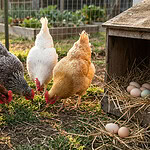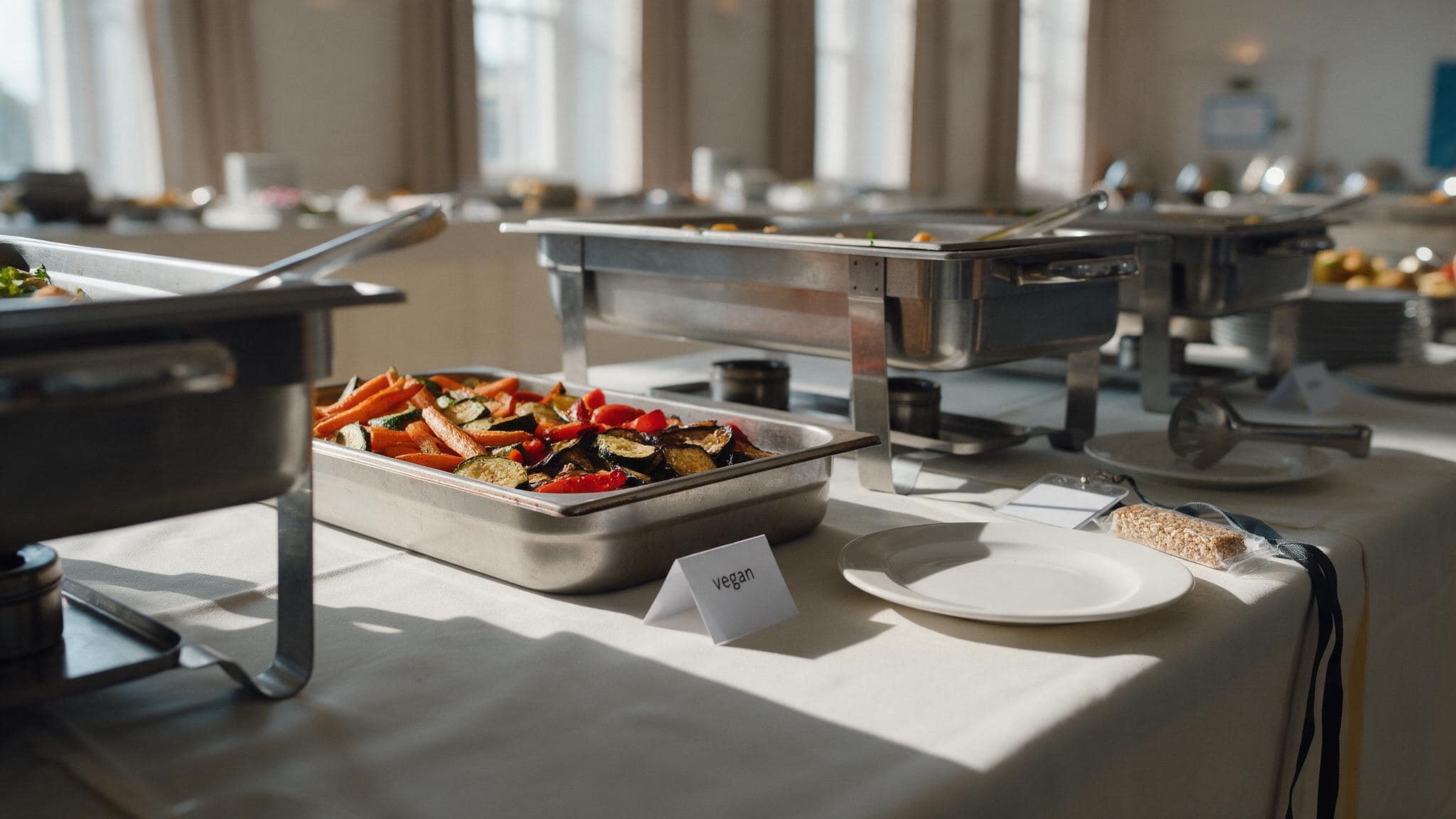

At a work event, ask about milk and egg instead of asking whether something is vegan, and carry a backup of your own. A “vegan” buffet card in the US has no legal definition, while milk and eggs are major food allergens that kitchens are already set up to track. Say you are vegan, not allergic, and ask anyway.
The little tented card is the weakest thing on the table. In the US, the government has not defined the term vegan, so it means whatever the person who printed the card thinks it means. The words milk and eggs are another matter. Both are on the FDA’s list of major food allergens, and packaged foods are misbranded unless they declare each major food allergen on the label by the name of its source. One of these words is regulated. The other is a mood. Ask in the regulated one.
Office parties make this a December problem as much as a conference one, and the holiday version of eating vegan comes with relatives attached. The work version comes with a lanyard, a coffee urn and a colleague watching you lift the lid on every tray.
Why does a “vegan” label on catering mean so little?
Because nobody owns the word. With no government definition, the industry has defined it, and it means different things depending on who you ask. Even a brand can get it wrong in its own advertising. The FTC’s 2019 complaint against Truly Organic said the company advertised its products as vegan even though certain products contained non-vegan ingredients like honey and lactose, and the company paid $1.76 million to settle. That was a brand making the claim in writing. A buffet card is somebody’s best guess, laminated.
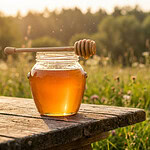
The allergen question has a gap of its own. The FDA list is milk, eggs, fish, crustacean shellfish, peanuts, tree nuts, wheat, soybeans and sesame, and labels are not required to name the source of allergens from foods outside that list in the same way. Honey is not on it. Gelatin, which is animal-derived, is not on it either. Asking about milk and egg catches the dairy in the dressing and the egg wash on the pastry, and it misses the honey glaze entirely. Those two you ask about by name.
What do allergen rules actually make someone tell you?
More than the packaged-food rules suggest, depending on where the event is. The FDA’s 2022 Food Code added a provision, 3-602.12(C), to inform consumers of major food allergens in unpackaged foods in writing. The Food Code is a model: state and local regulators use it to write their own rules, so whether the venue’s caterer is bound by that paragraph depends on what your state has adopted. Where it applies, the plated lunch is covered as well as the wrapped granola bar. Where it does not, the packaged snacks are where the law does the most work for you.
In a UK venue the rules are firmer. GOV.UK lists 14 allergens that food businesses must tell you about, including milk, eggs, fish, crustaceans and mollusks, and for loose food they must give you allergen information verbally or in writing. That guidance is written around food you buy, and a free conference lunch is not obviously food you bought. I would use it as a script rather than a threat.
Set the two lists side by side and the UK one names mollusks. The FDA list names crustacean shellfish and stops there. Oysters are mollusks, and oyster sauce is made from them, so at a US event the allergen question does not reach the stir-fry sauce. Ask about it.
And if shared equipment matters to you, no label settles it. The FDA says “may contain” statements are voluntary and there is no uniform rule that governs what they mean. Where you draw that line is yours, but the card will not draw it for you.
Is it fair to borrow the language of allergies?
People with real allergies depend on a kitchen treating the word as an emergency. If diners start using allergen vocabulary for a preference, the vocabulary loses its force, and the person whose throat actually closes is the one who pays for it. A kitchen that scrubs down a station for a vegan has less time for the guest who needed it scrubbed. On this view, a vegan reaching for allergy language is spending credibility that belongs to someone else.
That argument is right about the word “allergy”. It is wrong about the list. The site’s line is this: never say you are allergic when you are not, and use the allergen list as a vocabulary anyway. “I’m vegan, I’m not allergic. Is there milk or egg in this? And is there fish sauce or honey in the glaze?” is honest and tells the kitchen how serious to be. It also asks about ingredients they are already tracking for everyone else. Nothing in that sentence borrows anyone’s urgency.
I have stood in a buffet line rehearsing that sentence in my head, and it is still less awkward than eating three bread rolls and pretending that was the plan.
Ask before the day, and pack for the gaps
The best time to have this conversation is on the registration form, not at the chafing dish. Tick the dietary box, then write milk, egg, fish sauce and honey in the free-text field, because the word vegan on its own leaves the caterer to decide what it means. Earlier is kinder to whoever is placing the catering order.
Then pack something you do not have to interrogate. A packaged snack carrying the Vegan Society trademark is a known quantity in a way the tray is not. The Vegan Society says its team checks each product application against its criteria, which require that the manufacture and development of the product and its ingredients must not involve any animal product, by-product or derivative, and that neither involves testing of any sort on animals by or on behalf of the company. That is a standard somebody wrote down. The card on the buffet is not.
The team dinner afterward is its own negotiation, and you may not be the one choosing the restaurant. If it lands on pasta, our guide to ordering vegan at Italian restaurants covers what to ask about the sauce and the cheese.
The part of this I am least sure about is the sentence I recommended. “Vegan, not allergic” is honest, but it may also tell a busy kitchen it can relax about the shared ladle, and I do not know which way that trade falls for you. If you have found a phrasing that gets both honesty and care, it would travel well, and so would the rest of what we have on staying vegan on the road.
Sources
- Venable, on describing products as vegan: no US government definition
- FDA, food allergies: major food allergen list and labeling requirement
- FTC, 2019 press release on Truly Organic’s vegan and organic claims
- FDA, summary of changes in the 2022 Food Code: written allergen notification, 3-602.12(C)
- FDA, the Food Code as a model for state and local rules
- GOV.UK, allergen labeling: the 14 allergens and loose food
- FDA, “may contain” statements are voluntary
- Vegan Society, trademark standards