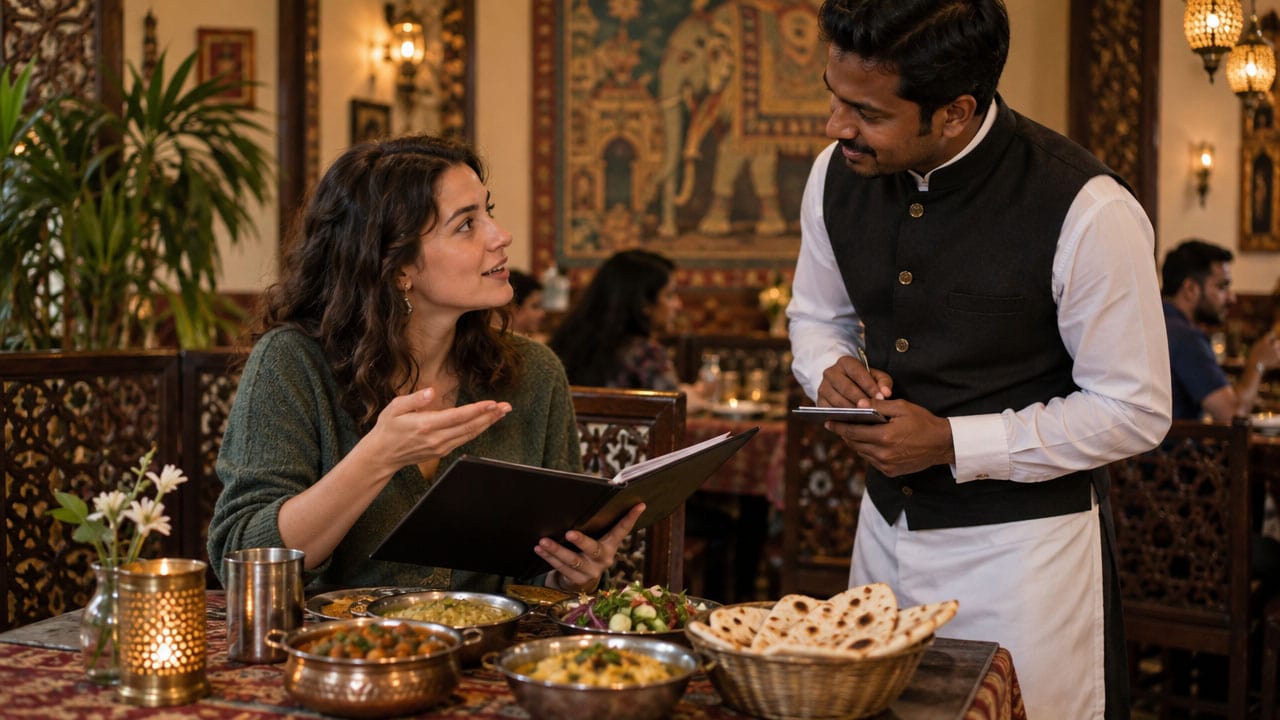

Order from the dal and vegetable side of the menu, then ask what fat each dish is cooked in and finished with. Ghee and paneer are both milk products under Indian food law, and on a menu full of paneer, “vegetarian” is not the same answer as “vegan”.
The most useful line in Indian food law, if you eat vegan, is about a fat that isn’t ghee. Vanaspati is refined vegetable oil that has been hydrogenated or interesterified, and the same standard says no color resembling the color of ghee may be added to it and any flavor used must be distinct from that of ghee. In effect, the law keeps the two fats from passing for each other. At a restaurant table that separation is one word wide. I have been told “it’s vegetable ghee” as reassurance more than once, and it took me longer than I’d like to admit to start asking what was actually in the tin.
I keep running into the same thing at Italian restaurants, where the menu describes the dish and not the pan. The fix is the same too. Ask about the fat.
What ghee and paneer are, by law
Indian law defines ghee, butter oil and anhydrous milk fat as fatty products derived exclusively from milk or milk products, made by processes that remove almost all of the water and the milk solids-not-fat. Read that slowly and the usual reassurance falls apart. A server who tells you ghee is fine because “the milk is cooked out” has the process right and the conclusion wrong. What the process leaves behind is the milk fat, and the milk fat is the ghee. Vanaspati starts from vegetable oil by its own definition, so it is a different question, and the answer to that one is on the tin. When you hear “ghee” with no adjective in front of it, assume milk fat until someone tells you otherwise.
Paneer is the product obtained from any variant of milk by precipitation with permitted acidulants and heating, and the permitted acidulants include vinegar and sour whey. So the thing that curdles the milk can be dairy as well. Even the leftovers count: the acid whey separated from the curd during paneer-making is classed as a fluid milk product. There is no reading of that definition with a plant in it.
Tofu cubes in a tikka sauce are another matter, and Indian rules are firm about the name. If a product is intended to substitute a milk product, dairy terms shall not be used, and no label, commercial document, publicity material or point-of-sale presentation may suggest that a non-dairy product is one. Those are India’s rules. On a menu anywhere else, “vegan paneer” is the kitchen’s own description, and it earns one question about what the cubes are and what the sauce is made with.
Cream has no legal surprises in it. It is exactly what it sounds like, which is why it gets missed: it goes into a sauce late and rarely makes it into the menu description. The heavy, pale sauces are the ones I ask about first, korma and makhani above all.
Why “does this contain milk?” gets a better answer than “is this vegan?”
“Vegan” asks the person taking your order to carry your definition back to the kitchen intact. Some will. Some will hear “vegetarian”, which on a menu full of paneer is an expensive mishearing.
“Milk” is a word some kitchens are legally obliged to answer for. In England, Wales and Northern Ireland, food businesses must inform consumers if they have used any of the 14 mandated allergens as an ingredient or processing aid, milk is on the list, and the rule covers meals in cafés and restaurants. Ghee, derived from milk under the Indian definition above, is exactly the kind of ingredient that wording catches.
The US is patchier. The 2004 federal allergen law names milk as a major food allergen, and for restaurants it directed the FDA to pursue revision of the Food Code to provide guidelines for preparing allergen-free foods. The 2022 Food Code added a paragraph, 3-602.12(C), on telling consumers about major food allergens in unpackaged food in writing. The Food Code is a model that state and local regulators use to write their own rules, so whether the curry house down the road is bound by it depends on your state. Ask about milk either way. The longer argument for asking in allergen words, without claiming an allergy, is in our guide to eating vegan at a work event, and it holds up just as well over a thali.
These are the questions I ask, phrased to get a real answer rather than a nod:
- What fat is the base cooked in?
- Is there cream, butter, yogurt or ghee in the sauce?
- Does anything go on top just before it leaves the kitchen, like a spoon of butter or spices fried in fat?
- Is the bread brushed with anything?
- Could it be made with oil instead?
The same script works at a relative’s table, which I worked out over more than one holiday dinner where “there’s no meat in it” was offered as the whole answer.
What to order once you’ve asked
Dal is the anchor. The catch is the tempering, the spices fried in fat and poured over the lentils at the end, and the fat in it is the one to ask about. Ask for it tempered in oil.
Chana masala, aloo gobi, bhindi masala and baingan bharta are the dishes I look for first. None of them needs paneer or cream to be itself, so asking for oil instead of butter doesn’t take the dish apart, and they are the dishes where a cook is least likely to look at you strangely for asking.
Bread needs its own question. Naan dough often has yogurt or milk in it. Roti and chapati are usually just flour and water, which makes them the better bet as long as nobody brushes them with ghee on the way out. Ask for it dry. A dry roti is a small sacrifice, and I say that as someone who has sulked about it.
The fryer question, and where we draw the line
Anything from the fryer, samosas and pakoras above all, raises a question no ingredient list can answer. The Scottish food regulator’s allergen training is blunt about shared oil: oil that has been used to cook food containing the allergen cannot be used to prepare allergen-free food, and the fryer must be emptied, thoroughly cleaned and refilled with fresh oil. The same guidance says equipment that is not washed between dishes, such as a seasoned wok, cannot be used to prepare allergen-safe food. So a vegetable pakora can be milk-free in its batter and still come out of the oil the paneer pakora just left.
Vegans who hold the strict line say contact is contact. If you would send back a paneer pakora, there is no principled reason to accept the oil it was fried in, and asking for fresh oil is the only way to know what touched your food. That position is consistent, and it asks nothing of the kitchen that the allergy guidance doesn’t already describe as doable.
The case on the other side is just as serious. Shared oil adds no dairy to your order and sends no extra money to a dairy farm. Your pakora is paid for the same whether the fryer was drained or not. And a kitchen asked to empty a fryer for one customer’s preference learns that vegan diners are hard work, which makes the next vegan’s dinner harder to order.
This is our line, and it is a line, not a ruling. Ask about ingredients every time, without apology, and treat shared oil and shared pans as your own call. If you have a milk allergy, that’s a different conversation: say “allergy” to the kitchen, because the allergy rules are the ones that change the oil. Don’t claim an allergy you don’t have to get a clean fryer. It teaches kitchens that allergy requests are negotiable, and the people who pay for that are the ones whose allergies are real.
The part I’m least sure about sits between those two cases, and it comes up every time I’m eating vegan away from home. When the onions for my chana masala go into a pan that was wiped, not washed, after the butter chicken, is that contact or an ingredient?
Sources
- FSSAI, dairy products and analogues standard: ghee, paneer, acid whey and the ban on dairy terms for substitutes
- FSSAI, fats and oils standard: vanaspati and the ban on ghee-like color and flavor
- Food Standards Agency, allergen information for non-prepacked foods
- FDA, Food Allergen Labeling and Consumer Protection Act of 2004
- FDA, summary of changes in the 2022 Food Code: written allergen notice, 3-602.12(C)
- FDA, the Food Code as a model for state and local rules
- Food Standards Scotland, allergen training module 5: shared fryer oil and unwashed equipment