
No, wool isn’t vegan. It is fleece from an animal, and a mulesing-free tag or a recycled label doesn’t change where it came from. It also turns up where you’d never look: Allbirds’ Tree Runner pairs a tree-fiber upper with a merino wool-blend lining.
That Tree Runner page is worth reading slowly. The upper is TENCEL lyocell and recycled polyester, the laces are recycled polyester from plastic bottles, the cushioning is sugarcane-based foam, and then, one line down, “Soft, Merino-wool blend lining”. The page never uses the word vegan, so nothing is being misrepresented. The name just does a lot of work. I would have bought that shoe on the word “tree” alone. If you are replacing wool with a synthetic, our answer on whether polyester is vegan covers the fabric you’ll probably end up reading about next.
Why isn’t wool vegan, even without mulesing?
Wool is shorn from sheep, and vegan rules out animal-derived materials whether or not anything cruel happened on the way. So the welfare question comes second.
It still gets most of the attention, because of mulesing. RSPCA Australia describes it plainly: fully conscious lambs are restrained while flaps of skin are cut away from their tail and hindquarters, so the scar tissue left behind attracts fewer blowflies. The same page says wool production has relied on it for nearly 100 years. Ending it is a real improvement for the lambs. The sweater is still made of sheep.
What does “mulesing-free” actually certify?
Less than the tag suggests, because both big standards accept farms that used to mules. The Responsible Wool Standard (version 2.2) prohibits mulesing, and in the same clause says “Farms with Ceased Mulesing status are accepted”. Its definition of ceased status is that no lambs born on the property in the last 12 months have been mulesed. ZQ’s grower manual requires a ceased status held “for at least one year prior to joining”.
| Responsible Wool Standard | ZQ | |
|---|---|---|
| Mulesing | Prohibited (clause AW3.11) | Not allowed on supplying properties (3.9.1.1) |
| Farms that mulesed before | Accepted with ceased status | Accepted with ceased status |
| How far back it looks | Lambs born in the last 12 months | At least one year before joining |
| How it’s checked | Certification audit | Random vet inspections or third-party audit |
The RWS also bans freeze mulesing, or steining, in a clause of its own. These are rules with teeth for the lambs they cover. A mulesing-free tag tells you about a farm’s last year, and nothing about whether the garment is vegan.
Eight wool and wool-free layers, read from the makers’ pages
Five of these contain wool and are the ones to skip. Three are the swaps.
| Product | Fiber, per the maker | Vegan? | Price when read (Oct 2026) |
|---|---|---|---|
| Allbirds Men’s Tree Runner | Lyocell and recycled polyester upper, merino wool-blend lining | No | $100 |
| Allbirds Men’s Wool Runner | Merino wool | No | $110 |
| Icebreaker Men’s Merino 200 Oasis Long Sleeve Thermal Crewe | 100% merino wool | No | $120 |
| Smartwool Men’s Classic Thermal Merino Base Layer Crew | 100% merino wool | No | $66 to $125 by color |
| Patagonia Men’s Recycled Wool-Blend Sweater | 65% recycled wool, 31% recycled nylon, 4% other fiber | No | $159 |
| Patagonia Men’s Synchilla Snap-T Fleece Pullover | Recycled polyester fleece | Yes, by fiber | $149 |
| Columbia Men’s Steens Mountain 2.0 Full Zip Fleece | 100% polyester | Yes, by fiber | $32.50 to $45.50 on sale, list $65 |
| Uniqlo Women’s HEATTECH Ultra Warm T-Shirt | Acrylic, polyester, rayon, spandex | Yes, by fiber | $34.90 |
“Yes, by fiber” means nothing animal appears in the fiber content the maker publishes. None of the three calls itself vegan.
Allbirds Men’s Tree Runner
The shoe from the opening, at $100. Everything visible is plant fiber or plastic, and the wool sits against your foot in the lining. Skip it, and treat any shoe with “tree” in its name as a reason to read the full materials list rather than a reason to stop.
Allbirds Men’s Wool Runner
At least this one says so in the name. Allbirds describes it as soft merino wool and says its wool “meets high standards of animal welfare”, without naming a standard on the product page. $110, and not vegan.
Icebreaker Men’s Merino 200 Oasis Long Sleeve Thermal Crewe
Icebreaker calls this its best-selling base layer, and the fabric is 100% merino wool. Its transparency page says it was among the first outdoor brands to ban mulesing, in 2008, and that it sources merino through Zentera’s ZQ program. None of that changes the fiber. $120.
Smartwool Men’s Classic Thermal Merino Base Layer Crew
Also 100% merino. Smartwool’s sourcing page says practices like mulesing “are never permitted” and that it buys through ZQ, whose manual, as the table above shows, admits farms that stopped a year before joining. Both statements can be true at once. The price ran from $66 to $125 depending on the color when I read it.
Patagonia Men’s Recycled Wool-Blend Sweater
65% recycled wool, 31% recycled nylon and 4% other fiber, at $159. That 4% can’t be hiding more wool: the FTC lets fibers under 5% be listed as “other fiber” but says wool must always be named, with its percentage, however small. Not vegan, for the reasons in the next section, and not one we’d buy.
Patagonia Men’s Synchilla Snap-T Fleece Pullover
The swap if you want one warm layer and are willing to pay for it, at $149. Nothing animal in the fiber list, and it is made in a Fair Trade Certified factory. The page can’t settle on the recycled share: 100% recycled polyester in the materials section, 95 to 100% in the description. It is also plastic, which is the trade you make with most wool-free warmth.
Columbia Men’s Steens Mountain 2.0 Full Zip Fleece
The budget pick, 100% polyester. It was on sale at $32.50 to $45.50 depending on color when read, against a $65 list price. If recycled content matters to you, the Synchilla is the one that states it.
Uniqlo Women’s HEATTECH Ultra Warm T-Shirt
The base layer to put where the merino crew would have gone: 35% acrylic, 34% polyester, 23% rayon and 8% spandex, at $34.90. That is less than a third of the Icebreaker’s price (our arithmetic). Uniqlo’s own note says recycled ratios vary by item and tells you to check the price tag or care label, which is good advice for every product on this page.
Is recycled wool vegan?
No research settles this one. It is about where vegans draw the line, and they draw it in different places.
The case for wearing it is serious. Recycled wool already exists, buying it sends no new money to a sheep farm, and many vegans reason the same way about wool they owned before going vegan or a coat from a thrift store.
The case against is just as serious. Recycled wool is still sold as wool, priced on wool’s reputation, and to anyone looking at you it is indistinguishable from the new kind. It keeps wool looking like the premium choice.
This site’s line is that recycled wool isn’t vegan, and we don’t recommend buying it new. What you already own or inherit is your call.
How to check a tag yourself
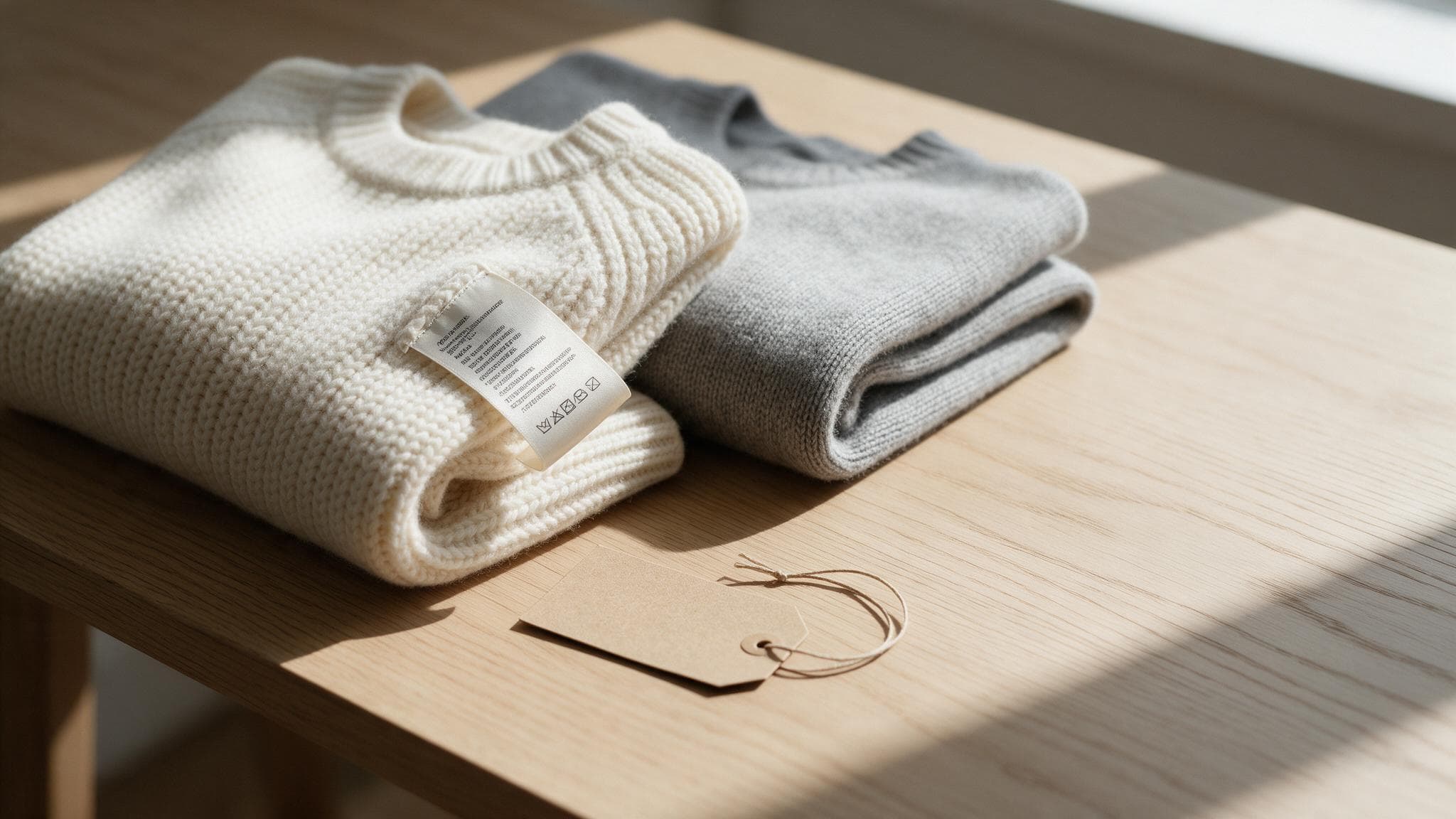
Read the sewn-in care label, not the hang tag. The hang tag carries the welfare logo; the care label carries the fiber percentages, and US rules make wool show up there by name and percentage even below 5%. Recycled wool has to be labeled as recycled wool.
“Wool” on a US label isn’t always sheep, either. The FTC lets the word cover the hair of Angora and Cashmere goats, camels, alpacas, llamas and vicuñas as well. None of them is vegan, so for your purposes it comes to the same thing.
Shoes need one extra step: check the lining and insole as well as the upper, because that is exactly where the Tree Runner keeps its merino. If the wool you are replacing was in a boot, the upper is the next question, and our guide to what vegan leather is made of covers that part.
Sources
- Allbirds, Men’s Tree Runner product page (materials, lining, price)
- RSPCA Australia, what is mulesing
- Textile Exchange, Responsible Wool Standard 2.2 (mulesing ban, ceased mulesing status, steining)
- ZQ Grower Standard Manual 5.0 (mulesing ban, ceased status, inspections)
- Allbirds, Men’s Wool Runner product page
- Icebreaker, Men’s Merino 200 Oasis Long Sleeve Thermal Crewe
- Smartwool, Men’s Classic Thermal Merino Base Layer Crew
- Patagonia, Men’s Recycled Wool-Blend Sweater
- Patagonia, Men’s Synchilla Snap-T Fleece Pullover
- Columbia, Men’s Steens Mountain 2.0 Full Zip Fleece Jacket
- Uniqlo, Women’s HEATTECH Ultra Warm T-Shirt
- Icebreaker, transparency page (2008 mulesing ban, ZQ partnership)
- Smartwool, ethically sourced wool (ZQ, mulesing)
- FTC, labeling requirements under the Textile and Wool Acts