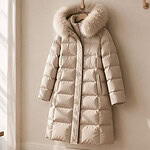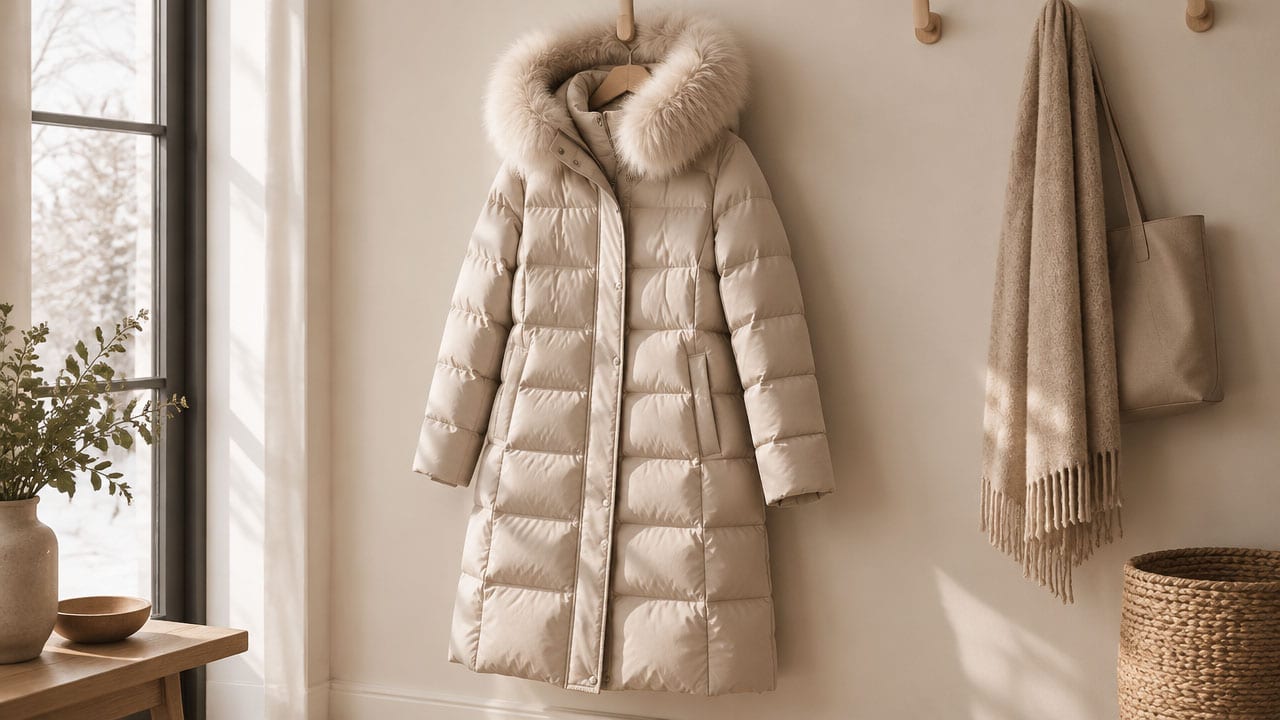

Our pick for real cold is the Noize Wendy, a long puffer rated to -22°F and $240 on sale when we read it, with shell, fill, lining and faux fur all listed as polyester. Noize says it uses no down, fur, wool or leather. Read every fill line, though, because one recycled puffer below is filled with down.
Everlane’s EverPuff Long is the coat that taught me to read a description to the very end. Its page says nearly every element, fill, lining and outer shell included, is made from certified recycled materials, apart from three small metal trims. The shell is bluesign certified and PFAS-free, and the coat is backed by a repair warranty. I was nodding along. Then the fill line says 100% Re:Down at 700 fill power, which the page says gives “the same lofty warmth as virgin down” while giving existing materials a second life. Every reassurance on that page is true, and none of them answers the question a vegan is asking, because recycled down is still feathers. Our answer on whether down is vegan explains why certified and recycled down both fail; this page is about what to buy instead.
The coats, and what each maker puts in writing
Seven winter coats and parkas, all read on the makers’ own US stores on 24 October 2026. Six have no animal material in anything their makers list. Save The Duck says it is 100% animal free, Noize says it uses no fur, wool, leather or down, and Wuxly says its insulation contains no animal materials. The other three are from big outdoor and clothing brands that make no vegan claim on these pages, so the verdict rests on the composition list alone.
| Coat | Fill, per the maker | Hood trim | Maker’s warmth claim | Vegan, per the maker? | Price when read |
|---|---|---|---|---|---|
| Noize Wendy | 100% polyester | Detachable faux fur, 100% polyester | Up to -22°F | Yes, no down, fur, wool or leather | $240 on sale, $320 list |
| Wuxly Elk Parka | 75% polyester, 25% Sorona | None listed, wire hood brim | Down to -30°C | Insulation “without animal materials” | $810 |
| Save The Duck Zendaya | Synthetic padding, Plumtech is polyester | None listed | “Extremely Warm” on its own index | Yes, 100% animal free | $628 |
| Uniqlo PUFFTECH Parka | 100% polyester | None listed | About 32°F | No claim, all polyester | $89.90 |
| Lands’ End FeatherFree Diamond Quilted Maxi Coat | 100% recycled polyester | None listed | -13°F to 18°F | No claim, all polyester | $239.95 list |
| Columbia Little Si II Insulated Parka | 100% recycled polyester | Synthetic fur, fiber not listed | “Maximum Warmth” | No claim | $250 |
| Everlane EverPuff Long | 100% Re:Down, 700 fill | None listed | Not stated | No, down | $104 on sale, $348 list |
Noize Wendy
Noize is the only maker here that names the fiber of its fur trim on the product page. Shell, fill, lining and faux fur are each listed as 100% polyester. The Wendy runs long, 40 3/8 inches from shoulder to hem, with side zip vents and a removable hood. Noize says it will shield you down to -30°C, which it gives as -22°F. It was $240 on the brand’s US store when I read it, 25% off a $320 list price.
The brand’s FAQ says all of its jackets are filled with recycled post-consumer water bottles, and that it uses no fur, no wool, no leather and no down, with no testing. The same page calls Noize 100% PETA approved.
The downside is the weather it is built for. The page calls it water resistant, while the Columbia and the Save The Duck below are sold as waterproof, so if your winter is mostly sleet and slush, look at those first.
Wuxly Elk Parka
Wuxly makes this one in Canada, and the page spells out every layer: a shell of 100% recycled polyester from post-consumer bottles, a lining of 100% recycled nylon from discarded fishing nets, and insulation that is 75% polyester and 25% Sorona, a fiber the page says is made from corn. The insulation is described as “delivering superior warmth without animal materials”, and the brand calls itself dedicated to cruelty-free apparel. The rating is “Down to -30°C”, which is -22°F by our conversion, the same figure Noize gives the Wendy.
Wuxly’s own story page says the company started in 2015 with an animal-free parka. These days the brand pages talk mostly about defence-grade and aerospace-grade performance, and the composition list on each product page is where the animal question gets answered.
At $810 on the US store it is the most expensive coat here, more than three times the Wendy’s sale price by our arithmetic. Both coats come out at -22°F, Wuxly’s by our conversion, so on warmth alone the extra money buys the Canadian label and seven outside pockets.
Save The Duck Zendaya
Save The Duck puts its animal rule in writing as a list: no feathers, skins, furs, silks, wools, horns, bones, mother of pearl, waxes, glues or dyes of animal origin. Its Plumtech padding is 100% polyester, and the recycled version is made from post-consumer PET bottles.
The Zendaya is the brand’s “super long” women’s parka, “designed for high winter”, with a two-layer recycled polyester shell rated waterproof to 10,000 mm. It sits at “Extremely Warm” on Save The Duck’s own warmth index, and it costs $628. Look at that index on every Save The Duck page rather than trusting the collection name. The Bethany, also in the Arctic collection and also a long quilted parka at $598, is rated only “Warm”. I would have bought the Bethany on the word Arctic.
The index gives words, not temperatures, so it cannot be set beside Noize’s -22°F. Returns are another cost: ground shipping was $20, and a return within 14 days has $20 taken off the refund.
Uniqlo PUFFTECH Parka
At $89.90 this is the lowest price of the seven. The women’s version lists face, back and filling as 100% polyester, and it ships in one of two versions, one of which uses 20% recycled polyester in the fill. Uniqlo makes no vegan claim, and nothing it lists comes from an animal.
Read the temperature before you buy. Uniqlo gives a recommended minimum of about 32°F, based on simulations by an independent third-party testing organization. That is a coat for a winter that hovers around freezing. If yours goes well below freezing, don’t buy this one as your only coat.
Lands’ End FeatherFree Diamond Quilted Maxi Coat
The full name is the Women’s FeatherFree Insulated Diamond Quilted Maxi Coat, and the fabric is 100% polyester with 100% recycled polyester body insulation and 120 grams of polyester insulation in the hood. It is 40 inches long in a regular small, and the page says it uses about 17 recycled plastic bottles per jacket.
The page cannot quite decide how warm it is. Its temperature rating, labeled warmest, runs from -13°F to 18°F, and a few lines further down the description calls it a go-to for cooler weather and in-between seasons. I have no idea which sentence the copywriter meant, so I would treat it as the middle of the range.
It was listed at $239.95 when I read it, with a sitewide code that day taking it to $119.97. Two warnings. It is water resistant rather than waterproof. And the row of suggestions under it offered the Max 600 Down Puffer Coat and the Max 600 Down Long Maxi Coat, so check the name of what ends up in your bag.
Columbia Little Si II Insulated Parka
Columbia lists an Omni-Tech faille shell in 100% polyester, a 100% polyester lining and 100% recycled polyester Thermarator insulation, and the parka is waterproof-breathable with critically seam-sealed construction. Inside is Columbia’s Omni-Heat Infinity lining with thermal-reflective gold dots, and the page files it under Maximum Warmth. It was $250.
The hood carries a removable, foldable synthetic fur. The materials list covers everything except that fur, which turns up again only in a care line for the faux fur trim. I have no reason to doubt Columbia’s word that it is synthetic. The fiber simply isn’t on the page, and under the trim rules below, the label inside may not have to name it either. If you want every part of the coat in writing, the Noize does that and the Columbia doesn’t.
Everlane EverPuff Long
Don’t buy this one. It is filled with 100% Re:Down at 700 fill power, which the page compares to virgin down. The navy was $104 on sale from $348 when I read it, and the discount is what makes it tempting. If the recycled story was the draw, the Lands’ End maxi coat uses recycled polyester for the same job.
Names on the fill line
Most of these makers put a trade name on the insulation or on the coat itself, and Everlane does the same for its down. None of those names says which side of the line a coat is on; the percentage beside the name does.
| Name on the coat | Whose | What the maker says it is |
|---|---|---|
| Plumtech, Recycled Plumtech | Save The Duck | 100% polyester padding; the recycled one from PET bottles |
| Sorona blend | Wuxly | 75% polyester, 25% Sorona, made from corn per the page |
| Thermarator | Columbia | 100% recycled polyester |
| PUFFTECH | Uniqlo | 100% polyester filling |
| FeatherFree (the coat’s name) | Lands’ End | 100% recycled polyester insulation |
| Re:Down | Everlane | Down, 700 fill power |
Fill power is a number used for down, so a fill-power figure on a tag is a reason to look twice. The trap also runs the other way within a single brand name. PrimaLoft sells a hybrid of goose down and PrimaLoft fibers under the same name as its synthetic fills, which our look at whether polyester is vegan walks through.
The hood trim, and what the label has to say
Real fur has its own labeling law. Under the Fur Products Labeling Act, a garment made entirely or partly with fur must carry a label naming the animal, and imported fur has to state its origin with the words “Fur Origin”. The FTC’s own example is a wool coat with fur trim, which has to disclose the wool content as well.
Faux fur gets no such treatment. Under the FTC’s textile rules, collars and cuffs are exempt trimmings, and decorative trim attached to a garment can go without a fiber statement if it covers no more than 15% of the surface, with the main fabric’s content followed by the words “exclusive of decoration”. So a polyester ruff on a hood may have no fiber listed on the label at all.
That leaves three possibilities when you turn the tag over. An animal name means real fur. A fiber name next to the trim, polyester or acrylic, means faux. If there is neither, the label has said nothing about the trim and you are back to trusting the product page.
Product pages have been wrong before. In 2013 three retailers, Neiman Marcus, DrJays.com and Revolve, agreed to settle FTC charges that they marketed products as having faux fur when the fur was real, and Neiman Marcus was also accused of describing a rabbit fur product as mink. A consent order is not an admission, and the FTC said so. It is still the reason I like a maker that lists the trim’s fiber the way Noize does.
“Fur-free” on a brand is a narrower claim than it sounds, too. Canada Goose ended its fur purchases in December 2021 and stopped manufacturing with fur at the end of 2022, and its animal welfare policy names down, leather and wool as its three most significant animal-derived materials.
Which one to buy
For most real winters, buy the Noize Wendy. It is the only coat here with a fur trim whose fiber the maker names, and it shares the lowest temperature rating on this page with the Wuxly at less than a third of the Wuxly’s price, by our arithmetic. Pay for the Wuxly Elk only if a Canadian-made parka is worth $570 more to you than the Wendy’s sale price (our arithmetic). Choose the Save The Duck Zendaya if you want a brand whose animal-free rule is written out item by item, and waterproofing to go with it. Buy the Uniqlo only where winter stays near freezing.
Skip the Everlane EverPuff Long, whatever the discount. And skip every coat on this page if you are avoiding synthetic fibers, because all six that passed are synthetic: polyester throughout, with a recycled nylon lining in the Wuxly.
Before you pay, turn the coat inside out and read every tag, the lining included. A lining sewn in only for structure does not have to be listed at all, which is the mistake I own up to in our answer on whether silk is vegan.
Sources
- Noize Wendy hooded long puffer parka: shell, fill, lining and faux fur composition, rating, length, price
- Noize FAQ: recycled fill, no fur, wool, leather, down or testing, PETA approved
- Everlane EverPuff Long: certified recycled materials, bluesign, PFAS-free, repair warranty, 100% Re:Down at 700 fill power, price
- Wuxly Elk Parka: shell, lining and Sorona insulation, “without animal materials”, rating, price
- Save The Duck, We respect animals: 100% animal free, excluded materials, Plumtech and Recycled Plumtech
- Uniqlo Women’s PUFFTECH Parka: composition, recommended minimum temperature, price
- Lands’ End Women’s FeatherFree Insulated Diamond Quilted Maxi Coat: fabric and insulation, temperature rating, price, suggested coats
- Columbia Women’s Little Si II Insulated Parka: materials, synthetic fur, care, warmth level, price
- Save The Duck Women’s Parka Zendaya: warmth index, waterproofing, price, shipping and returns
- Wuxly, our story: founded 2015 with an animal-free parka
- Wuxly, our materials: Sorona blend, defence-grade performance
- Save The Duck Women’s Parka Bethany: Arctic collection, warmth index Warm, price
- PrimaLoft, Gold Down Blend: a hybrid of goose down and PrimaLoft fibers
- FTC, How to comply with the Fur Products Labeling Act: animal name, Fur Origin, the fur-trimmed wool coat
- 16 CFR 303.12, trimmings exempt from fiber disclosure and the 15% decoration rule
- FTC, Retailers agree to settle FTC charges they marketed real fur products as fake fur (March 2013)
- Canada Goose animal welfare policy: fur purchases ended December 2021, manufacturing with fur ended 2022, down, leather and wool
- FTC, Threading your way through the labeling requirements under the Textile and Wool Acts: linings and fillings used only for structure need no fiber disclosure