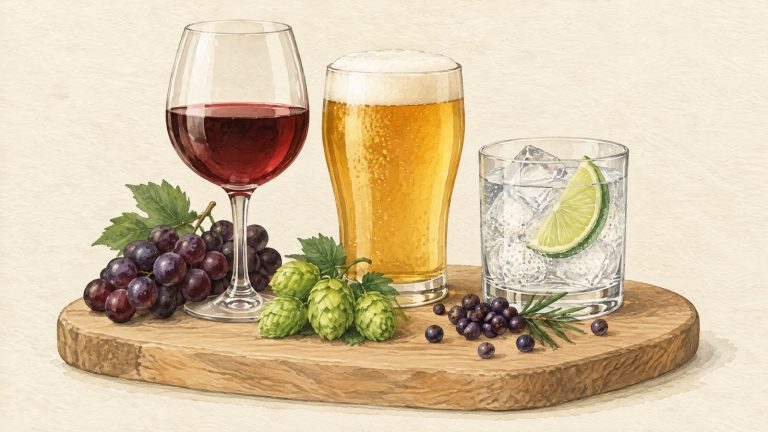

Beer is vegan when nothing from an animal goes into the brew or into clearing it, and Corona and Guinness Draught both say theirs is suitable for vegans. Of the six beers below, the three that fail each give the reason on the brewer’s own page: lactose, honey or, in one Budweiser, shellfish.
Budweiser and Budweiser Chelada share a name and every ingredient on Budweiser’s list. AB InBev’s ingredient site lists Budweiser as water, barley malt, rice and hops. The Chelada keeps all four, adds Clamato concentrate, corn, corn syrup, hop extract and malt extract, and its ingredient page states that it contains shellfish. That warning, on AB InBev’s own page, is a courtesy. TTB’s rules for beer labels do not require major food allergens to be declared; a brewer may declare them but does not have to. So the brand name settles nothing, and a label with no warning on it has not told you anything either. A cereal box at least has an ingredient list, which is why our guide to checking whether ingredients are vegan works better in the cereal aisle than on a six-pack.
What a beer label has to tell you, and what it doesn’t
Beer made from malted barley and hops is labeled under rules from the Alcohol and Tobacco Tax and Trade Bureau (TTB). TTB’s own allergen guidance, last updated in October 2026, says its rules do not require allergen disclosure on alcohol labels, and that disclosure stays optional pending final rulemaking on its proposal to make it mandatory. Until that rule is final, a milk ingredient or a fining agent made from fish can go unmentioned on the can.
There is one exception in the aisle, and it comes from a definition. To count as a “malt beverage” under the Federal Alcohol Administration Act, TTB ruled in 2008, a beer has to be made from both malted barley and hops. A beer brewed from a substitute such as rice or corn with no malted barley, or brewed without hops, is still beer for tax purposes, but it falls outside TTB’s malt beverage labeling rules and under the FDA’s ingredient and labeling requirements instead. For those beers the FDA says the major food allergens must appear on the label. In practice a sorghum beer with no barley in it has to list its ingredients under FDA rules, while the barley lager beside it needs no full ingredient list. TTB requires that lager’s label to name only a few things, such as cochineal extract or carmine, the insect-derived red colors, when either is used.
On a TTB-labeled can, read the name before the small print. One of the three failures below gives itself away in the name: the milk stout. The other two do not. The Budweiser Chelada’s name mentions neither Clamato nor shellfish, and Bell’s Hopslam has honey in its description and ingredients on Bell’s page but not in what it is called.
Six beers, read on the brewers’ own pages
We read each brewer’s own page in November 2026. Two say outright that their beer is suitable for vegans, one lists nothing from an animal without saying either way, and three list an animal ingredient.
Corona Extra
Corona’s US FAQ answers the question in one line. Corona products are vegan friendly, it says, and the brewer does not use any products derived from animals. The answer is written for the brand as a whole, and the same page names Corona Extra, Light, Familiar, Premier, Non-Alcoholic and SunBrew elsewhere. Because it covers anything the brewer uses, not just the recipe, it is the most complete answer of the six.
The weak spot is not animal at all. Corona says all six of its beers are made from malted barley and that traces of gluten remain after fermentation, and it says Corona products are not kosher certified. If you need a gluten-free beer, or a kosher symbol on the bottle, this is not the one.
Guinness Draught
Isinglass is a fining agent made from fish, and Guinness once used it. Its US FAQ says a newer filtration process has removed isinglass, and that this made Guinness Draught, Guinness Extra Stout and Guinness Foreign Extra Stout suitable for vegans. The same FAQ lists roasted barley, malted barley, hops, yeast and water, and calls the beer dairy-free. So the stout that looks most like it has cream in it has none.
The answer names those three beers and no others. If the tap says Guinness and something else, ask which one it is before you order on the strength of this page.
Budweiser
AB InBev’s ingredient site lists water, barley malt, rice and hops for Budweiser, and nothing else. Nothing on that list comes from an animal. The page does not use the word vegan, though, and an ingredient list describes the recipe, not how the beer was clarified. If you need the brewer’s word on processing as well as ingredients, Corona and Guinness give it and this page does not.
Budweiser Chelada
Not vegan. The ingredients run water, Clamato concentrate, barley malt, rice, corn, corn syrup, hops, hop extract and malt extract, and the page flags that it contains shellfish. It is a 5% beer, and with Budweiser in its name it is easy to take for a lager with a splash of mixer. Skip it, and skip any chelada whose brewer’s page or can says it contains shellfish.
Left Hand Milk Stout Nitro
Left Hand lists its malts, then its hops, then one more ingredient under a heading of its own, and that ingredient is lactose. Lactose is the sugar in milk, so this 6% stout is not vegan. The page never uses the word dairy or the word vegan; the style name on the label does the warning for it. Do not buy it, or any milk stout, for a vegan table.
Bell’s Hopslam
Bell’s describes Hopslam as a Double IPA with six hop varieties and a dollop of honey, and lists honey last, after the house ale yeast. It is 10% alcohol and listed as a limited-time offer. Honey sits in the belief layer rather than the factual one: some vegans eat it, and our reasons for not doing so are in why some vegans eat honey, and why we still don’t. By that line, Hopslam is out, and so is any can that says brewed with honey.
Where the animal gets into a beer
It gets in two ways, and the second is the harder one to spot. The first is an ingredient the brewer means you to taste, lactose in a stout, say, or honey in an IPA. All three of the failures above list theirs on the brewer’s own page, and the milk stout puts it in the name as well.
The second is a processing aid. Fining agents such as isinglass are added to clear the beer and settle out with the haze, and while allergen disclosure stays optional, a brewer does not have to name a fish-based fining on the label. Guinness is the clearest example of a beer that changed on this point, and its own FAQ is where we found the change recorded. For a beer you have not seen on this page, the brewer’s own FAQ is where we would look for the processing answer, and Corona’s answer, which covers everything it uses, is the kind you are looking for.
Order a Guinness Draught or a Corona, and treat the words milk stout or chelada on a can as a no until the brewer’s own page says otherwise. For wine and spirits, where cream and honey turn up in liqueurs, our guide to which alcohol is vegan checks five bottles from the makers’ own pages.
Sources
- Corona USA, FAQs: vegan, gluten and kosher answers
- Guinness US, frequently asked questions: isinglass removed, vegan beers named, ingredients, dairy-free
- Left Hand Brewing, Milk Stout Nitro: malts, hops, lactose, ABV
- Bell’s Brewery, Hopslam Ale: ingredients including honey, ABV, limited-time offer
- AB InBev, Tap Into Your Beer: Budweiser Chelada (United States) ingredients, contains shellfish, ABV
- AB InBev, Tap Into Your Beer: Budweiser (United States) ingredients
- TTB, major food allergen labeling FAQs: disclosure optional pending final rulemaking
- TTB Ruling 2008-3: beers not made from both malted barley and hops fall under FDA labeling
- FDA, revised guidance on labeling of certain beers: major food allergens must appear on the label
- 27 CFR 7.63 (Cornell LII): mandatory ingredient disclosures on malt beverage labels, including cochineal extract and carmine