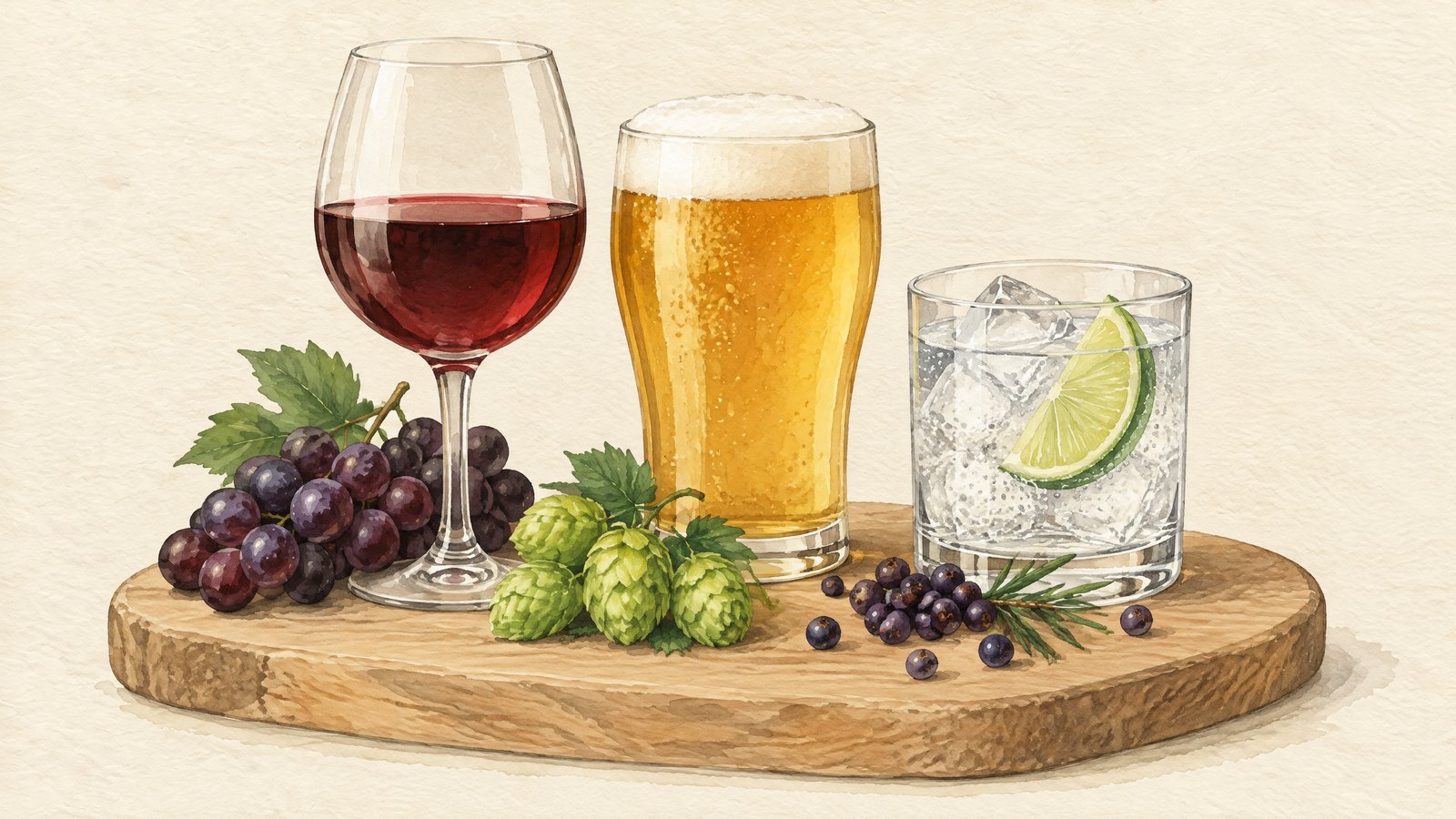

It depends on the bottle, and a US label will not settle it, because alcohol labels do not have to list ingredients or allergens. The animal products that do turn up are fining agents in wine and beer, cream and honey in liqueurs, carmine coloring, and, in one case below, the sugar.
That last one is Kahlúa. Its own FAQ says the brand adds no animal derivatives to its products, then says Kahlúa Original, the flavored versions and the ready-to-drink cans are not acceptable for a vegan or vegetarian diet, because one of its sugar suppliers uses a process that is not considered vegan-friendly. Kahlúa calls this common practice in the sugar industry. It does not name the process. So a bottle can fail on an ingredient that appears in no list at all, which is the whole difficulty with this aisle. Reading a food label is easier, and our guide to checking whether ingredients are vegan covers that side.
Why the bottle does not tell you
Alcohol labels in the US are regulated by the Alcohol and Tobacco Tax and Trade Bureau (TTB), not the FDA, and TTB’s own proposal says its current rules require neither an ingredient list nor an allergen declaration on alcohol labels. In January 2025 TTB proposed making allergen labeling mandatory, including fining agents made from egg, milk or fish, with an optional “(processing aid)” note. Nothing we read showed that proposal becoming a final rule.
What the rules do allow is a long list of treatments. TTB’s regulation on materials for treating wine authorizes casein, egg white, gelatin, isinglass and pasteurized milk products for clarifying or fining, alongside bentonite clay, activated carbon, PVPP, a potato protein and chitosan from the fungus Aspergillus niger. Isinglass comes from fish swim bladders. A winemaker can reach for either half of that list and the label looks the same.
One ingredient is the exception. Cochineal extract and carmine, the red colors made from insects, must be named on alcohol labels when present, as “Contains cochineal extract” or “Contains carmine”. That is the only animal-derived ingredient a US bottle has to own up to.
What can make a drink not vegan
Beer and wine are mostly at risk from the clarifying step, because fining agents are added to settle out haze and are then removed. [yellow tail] says all its wines are made with the aid of milk, eggs, fish or a vegan-friendly fining product, and that these are removed during filtering before bottling. Removed or not, an egg or fish product used to make the wine rules it out for us, and [yellow tail]’s own chart marks those wines as not vegan as well.
Liqueurs are a different problem. In a liqueur the cream or the honey is an ingredient, not a processing step, and at Kahlúa so, in effect, is the sugar. Plain spirits sit in between. TTB’s allergen proposal would let distillers skip declaring an allergen that has been through distillation, so that no protein remains, but anything added to the spirit afterwards is a different matter.
Six drinks, checked with the makers
We read each maker’s own site in October 2026, the US version where there is one. Three are fine for vegans, at least in part, and three are not.
Guinness Draught
Guinness says a newer filtration process removed isinglass and made Guinness Draught, Guinness Extra Stout and Guinness Foreign Extra Stout suitable for vegans. That covers the stout most people mean when they order a Guinness. It does not cover every beer under the name; Baltimore Blonde and Guinness 0, for two, are not in that answer. If your bar’s Guinness is the Draught, drink it; if it is anything else on the tap list, ask.
[yellow tail]
The useful one, because the maker publishes a verdict for every wine. Its US nutrition chart marks the Pinot Noir, Merlot, Shiraz, Shiraz Cabernet, Cabernet Sauvignon, Cabernet Merlot, Pinot Grigio, Sauvignon Blanc, Moscato and Pink Moscato as vegan. It marks Big Bold Red, Jammy Red Roo, Smooth Red Blend, Riesling, Rosé, both Sangrias and every Chardonnay as not vegan, and the vegan wines carry a vegan symbol on the back label. Do not buy the Chardonnay assuming the brand is safe. The symbol on the back is the check that matters.
Frey Vineyards
Frey says it has committed to making its organic wines without using any animal byproducts in the winemaking process, and lists vegan among its standards alongside USDA Organic and no added sulfites. It also calls itself the first certified organic winery in the US. Of the six, this is our pick for wine: the commitment covers the whole range, so there is no chart to consult. What it is not is a certification; it is the winery’s own statement on its homepage, and if you need a third party’s mark on the bottle, this is not the one.
Kahlúa
Not vegan, by the maker’s own answer, because of the sugar. The same FAQ says Kahlúa Original and its flavors contain no allergens, so a reader avoiding milk for allergy reasons and a vegan reader get different answers from the same bottle. If you are making a coffee cocktail, Kahlúa is the ingredient to replace.
Baileys Original Irish Cream
Not vegan. Baileys describes it as Irish whiskey and spirits with Irish dairy cream, and its US product page lists milk and milk products, lactose included, as allergens. Baileys’ US range page lists six products, and none of them is described there as vegan or dairy-free.
Jack Daniel’s Tennessee Honey
Jack Daniel’s describes this one as its whiskey blended with a honey liqueur it makes itself, using real honey. Honey is a belief-layer question rather than a factual one, and some vegans eat it; our reasons for not doing so are in why some vegans eat honey, and why we still don’t. By that line, the honey bottle is out.
Before you buy anything not on this list, look for a vegan symbol on the back label, look for “Contains cochineal extract” or “Contains carmine”, and check the maker’s own FAQ, since most of the answers above came from one. The ingredients that catch people out in food work much the same way, and the list of them is in our piece on unexpected foods that are not vegan.
Sources
- Federal Register (Jan 2025): TTB proposed rule, major food allergen labeling for wines, distilled spirits and malt beverages
- Kahlúa: frequently asked questions (is Kahlúa vegan?)
- 27 CFR 24.246: materials authorized for the treatment of wine and juice
- TTB: wine labeling, color ingredient disclosures (cochineal extract and carmine)
- yellow tail US FAQs and nutrition chart (vegan column)
- Guinness US: frequently asked questions (is Guinness vegan friendly?)
- Frey Vineyards: vegan, organic and no sulfites added
- Baileys Original Irish Cream, US product page
- Baileys US product range
- Jack Daniel’s Tennessee Honey