
Not as a rule: we found no study comparing how old vegans and meat eaters look. In the research we read, sun and smoking age a face, and in one study of identical twins, so did a 4-point lower body mass index after 40. In the EPIC-Oxford cohort, vegans had the lowest average BMI.
Weight is where the twins study surprises. Researchers at the Twins Day Festival in Twinsburg, Ohio, photographed 186 pairs of identical twins, and a panel recorded the difference in how old the twins in each pair looked. A body mass index 4 points higher went with an older appearance before 40 and a younger one after it, and an 8-point gap flipped the same way at 55. The heavier twins also had less dark, patchy discoloration and more hair. In EPIC-Oxford, the cohort behind most of the British numbers in our look at whether vegans are healthier, the vegans’ age-adjusted average BMI was 22.49 for men and 21.98 for women, against 24.41 and 23.52 for meat eaters. That is 1.5 to 1.9 points lower (our arithmetic), less than half the smallest gap the twins abstract reports.
Who says vegans look old?
A man I sat next to on a flight to Texas, for one. He noticed my vegan meal, we got talking, and he told me a vegan friend of his looked much older than his age. I asked how old he thought I was. Late twenties, he said, beard and all. I was 43.
The belief has a better case than a stranger on a plane, and it is the twins data above. If a lower BMI makes a face over 40 look older, and vegans have a lower BMI, then a vegan face over 40 could look older without the diet doing anything to the skin. The argument lacks the step in the middle. The twins abstract reports nothing about what anyone ate, and the vegans’ gap of 1.5 to 1.9 points (our arithmetic) is smaller than any it reports.
What ages a face
The same twins study found that the longer a twin had smoked, the older they looked, and that more sun exposure, a history of outdoor activities and lack of sunscreen use went with an older appearance too. The twins who smoked had more visible wrinkles and more dark, patchy skin.
A study of 298 Caucasian women aged 30 to 78 put a number on the sun. Twelve trained experts graded 22 clinical signs on each face, comparing 157 women whom dermatologists classed as sun-seeking with 141 classed as sun-phobic, and the authors concluded that UV exposure seems to be responsible for 80% of visible facial aging signs. Sagging was linked more to age, with no difference between the groups. Neither abstract reports a diet finding, and Flament’s mentions diet only in its background, among lifestyle factors with important and obvious effects on skin aging.
Is there a vegan glow?
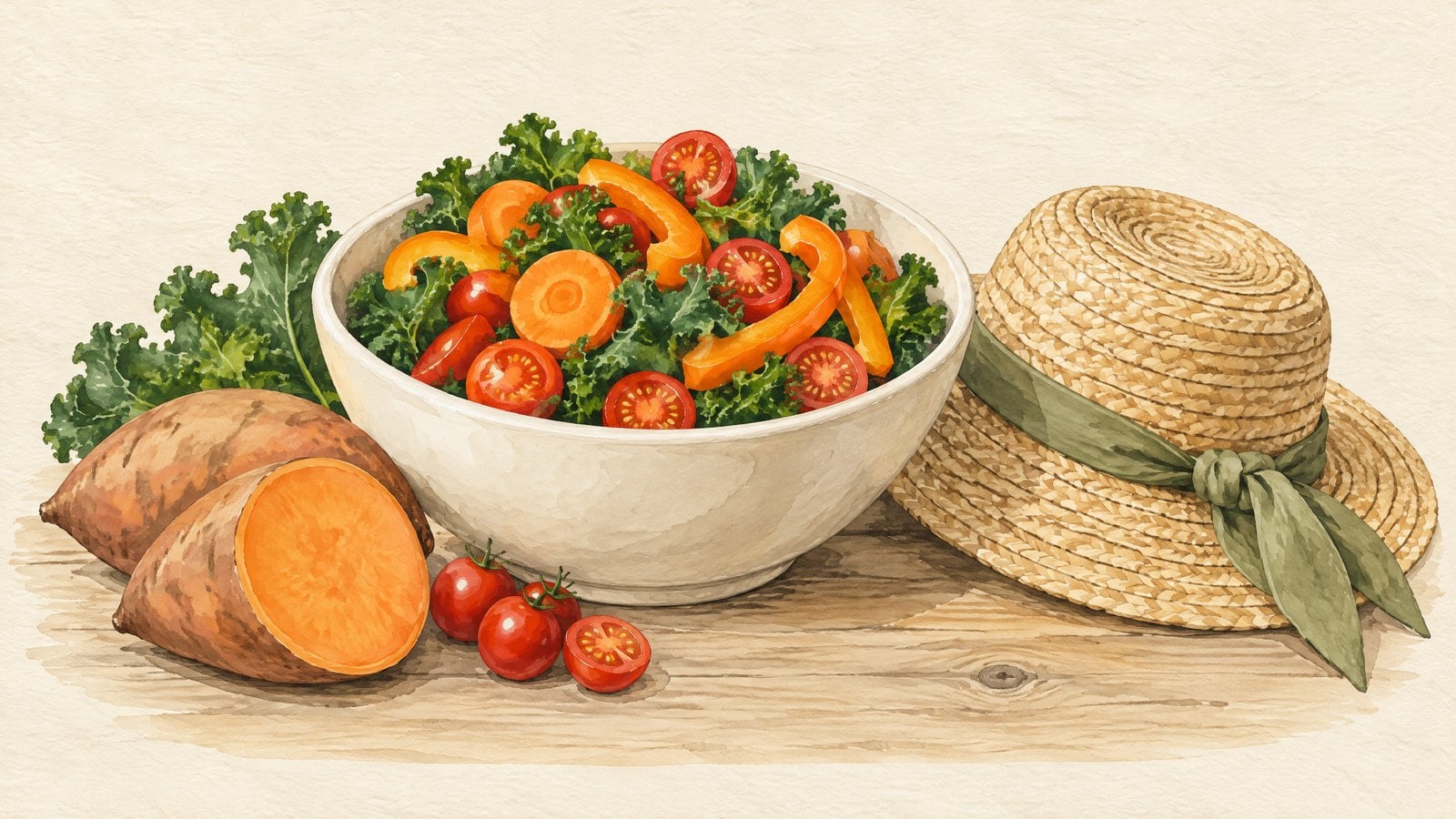
There is a fruit-and-vegetable glow, which is not quite the same thing. In one study, 35 people had their diet and skin color recorded over 6 weeks, and changes in how much fruit and vegetables they ate tracked changes in how red and yellow their skin turned, a shift linked to carotenoids rather than melanin. By the authors’ estimate, an extra 2.91 portions a day was enough for skin to look perceptibly healthier, and 3.30 for it to look more attractive. The study covered Caucasian skin and measured fruit and vegetables, not veganism, so by its measure a vegan who lives on pasta and fries is not eating the portions that did it.
The clear-skin half of the glow story points at dairy. A 2018 meta-analysis of 14 studies and 78,529 people aged 7 to 30 found that any dairy, compared with none, went with 25% higher odds of acne (our arithmetic from an odds ratio of 1.25). The authors say the results should be read with caution because of heterogeneity and bias across the studies. The studies were observational and covered people up to 30, so they say nothing about wrinkles at 50.
Does a vegan diet slow aging?
On a blood test, maybe, briefly. In the 8-week Twins Nutrition Study, one twin of each pair ate vegan and the other ate a healthy omnivorous diet, and the vegan twins showed significant decreases in overall epigenetic age acceleration, estimates of biological age read from DNA in the blood. The authors’ summary links a short-term vegan diet to epigenetic age benefits and reduced calorie intake, and the full paper adds that the differences may be mainly due to weight loss. In the same trial, the vegan twins lost 1.9 kg (about 4 lb, our conversion) more than their siblings. A methylation clock is not a face, and neither abstract mentions skin or faces.
Our line, on these papers alone, is that neither face study we read reports a diet finding, while both give anyone a reason to expect an older face from the sun, and the twins study adds cigarettes. If you are worried about your skin, a dermatologist is a better judge than a stranger on a plane.
The part we are least sure about is weight. Nobody we read has photographed vegans and meat eaters of the same age and asked a panel to guess, and until someone does, the lean-face argument stays a plausible chain with a missing link. Meanwhile one factor the twins study measured, lack of sunscreen use, is one anyone can change, and our roundup of vegan sunscreens reads seven bottles from the label.
Sources
- Guyuron et al., Factors contributing to the facial aging of identical twins, Plastic and Reconstructive Surgery, 2009
- Flament et al., Effect of the sun on visible clinical signs of aging in Caucasian skin, Clinical, Cosmetic and Investigational Dermatology, 2013
- Spencer et al., Diet and body mass index in 38000 EPIC-Oxford meat-eaters, fish-eaters, vegetarians and vegans, International Journal of Obesity and Related Metabolic Disorders, 2003
- Whitehead et al., You are what you eat: within-subject increases in fruit and vegetable consumption confer beneficial skin-color changes, PLoS One, 2012
- Juhl et al., Dairy intake and acne vulgaris: a systematic review and meta-analysis of 78,529 children, adolescents, and young adults, Nutrients, 2018
- Dwaraka et al., Unveiling the epigenetic impact of vegan vs. omnivorous diets on aging: insights from the Twins Nutrition Study (TwiNS), BMC Medicine, 2024
- Landry et al., Cardiometabolic effects of omnivorous vs vegan diets in identical twins: a randomized clinical trial, JAMA Network Open, 2023