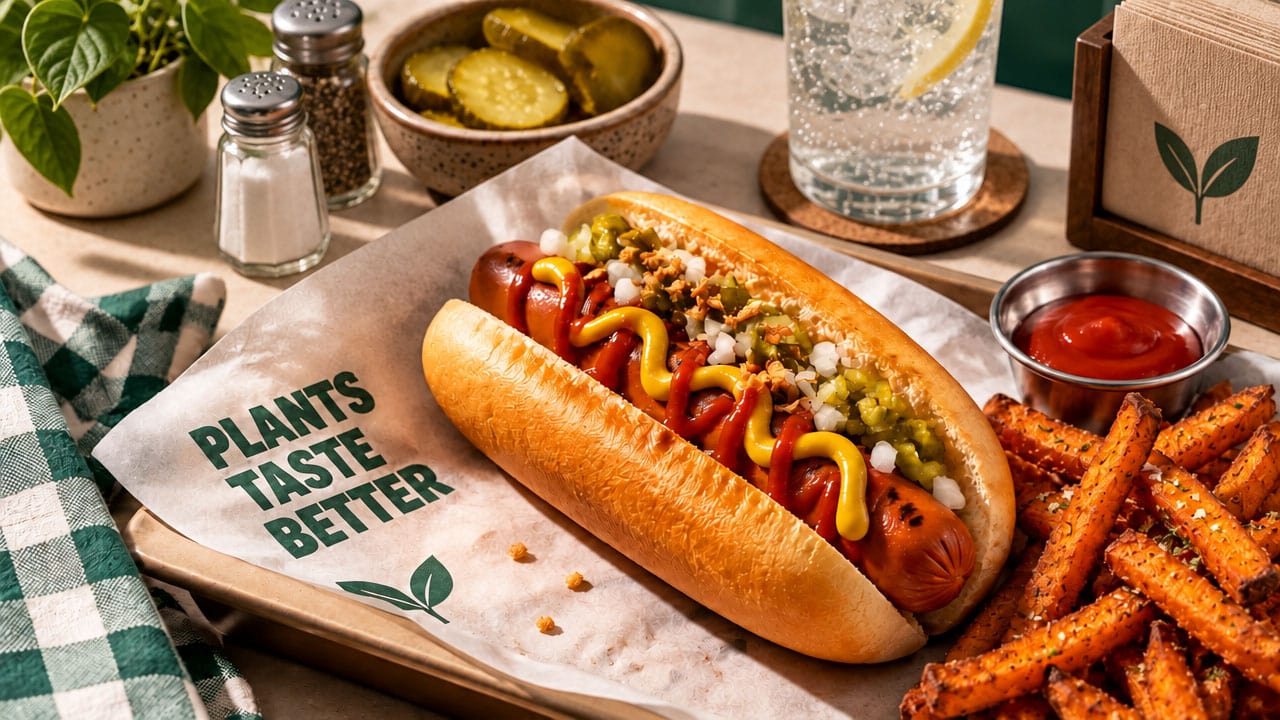

Our pick is Lightlife Smart Dogs: the pack carries the Certified Vegan mark, and each link has 60 calories, 8 g of protein and 350 mg of sodium. For more protein, Impossible’s dog has 12 g, but its sodium matches the beef dog it compares itself to, and its no-nitrite claim has a footnote.
The old version of this page said vegan hot dogs don’t contain nitrates, so there was nothing to be concerned about. Impossible’s own page puts it differently. It says “NO Added Nitrates or Nitrites”, then adds in a footnote, “Except those naturally occurring in cultured celery powder”, and cultured celery powder is on its ingredient list next to cherry powder “to promote color retention”. In a 2020 letter answering a petition that named celery powder as a non-synthetic source of nitrates or nitrites, the USDA’s meat inspection agency said it intends to approve such sources as curing agents. The same letter said it planned to propose banning “No Nitrate or Nitrite Added” and “Uncured” on meat and poultry products processed with any source of them. Impossible’s footnote is more candid than the old version of this page was. None of the other five lists celery powder. For what goes into plant-based meat in general, our guide to how vegan meat is made covers the proteins and binders.
The six side by side
Figures are per link, from the panel on or pictured on each maker’s own page. The sodium share is the panel’s own % Daily Value, except for Impossible, where the page gives milligrams only and the percentage is our arithmetic against the FDA’s 2,300 mg Daily Value. Brands change recipes, so the pack in your hand outranks this table.
| Hot dog | Link | Calories | Sodium | Protein | Vegan marking on the maker’s page |
|---|---|---|---|---|---|
| Lightlife Smart Dogs | 43 g | 60 | 350 mg, 15% | 8 g | Certified Vegan logo |
| Field Roast Signature Stadium Dog | 47 g | 110 | 310 mg, 14% | 5 g | Vegan badge |
| Impossible Beef Hot Dogs | 47 g | 120 | 430 mg, about 19% (our arithmetic) | 12 g | None; “Meat From Plants” |
| MorningStar Farms Veggie Dogs | 40 g | 60 | 370 mg, 16% | 9 g | “KOSHER DAIRY, VEGAN” |
| Field Roast Classic Smoked Frankfurters | 85 g | 200 | 670 mg, 29% | 22 g | Vegan badge |
| Loma Linda Big Franks (canned) | 51 g | Not on the page | 280 mg, 12% | 9 g | “Vegan” in its product facts, no certification mark |
Link sizes run from 40 g to 85 g, so counting per link flatters the big frank. Per 100 g (our arithmetic), the Field Roast Classic and the Impossible dog come out about level at 26 g of protein, MorningStar next at about 22.5 g, and the Stadium Dog last at about 11 g.
All six ingredient lists name no animal ingredient. Several list natural flavors without saying where they come from; for all but Impossible, the maker’s page also calls the product vegan. That is the bar for being on this list; the rows below are about what else you are buying.
The six, one by one
Lightlife Smart Dogs
The list runs to 20 ingredients: water, soy protein isolate, soybean oil, raw cane sugar and salt, then a run of minor ingredients from pea protein and tapioca starch through to red rice flour and paprika oleoresin for color, with soy declared. The certifications pictured on Lightlife’s page include Non-GMO Project Verified, K Pareve and the Certified Vegan mark of vegan.org. A pack is 8 dogs and 12 oz.
This is our pick because it does the ordinary job without surprises: 60 calories and 8 g of protein a link, 350 mg of sodium, and a third-party vegan mark on the pack rather than a word in the marketing. The pack pictured on the page also says it contains pea protein and may not suit people with a peanut allergy, and to use or freeze the dogs within 3 to 5 days of opening.
The flaw is the link itself. At 43 g it is the second-smallest dog in the table, and if you want a frank that fills a bun on its own, two Smart Dogs weigh about what one Field Roast Classic does (our arithmetic).
Field Roast Signature Stadium Dog
Pea protein is the main protein here, after water and soybean oil, with potato starch to bind it and smaller amounts of brown rice protein, faba bean protein, wheat gluten and soy protein isolate; wheat and soy are declared. Field Roast prints the same peanut warning about its pea protein. Cherry powder turns up again, labeled for color retention in the same words Impossible uses, but without the celery powder beside it.
The panel on Field Roast’s page gives 110 calories, 7 g of fat and 310 mg of sodium for a 47 g link, which is the second-lowest sodium in the table. Protein is 5 g, the same as the leading beef dog in Impossible’s comparison. Buy it for the sodium and the bite; don’t buy it for protein, because every other dog here carries more.
Impossible Beef Hot Dogs
This is the high-protein dog that isn’t a frankfurter: 12 g in a 47 g link, against 5 g for the leading animal beef hot dog in Impossible’s own table. Saturated fat is half the beef dog’s, 2.5 g against 5 g. Sodium is not lower. The same table gives 430 mg for both.
The base is water, wheat gluten, sunflower oil and coconut oil, with soy leghemoglobin, the heme ingredient, among the minor ones. Soy and wheat are declared, and a pack is 6 links and 10 oz. The page does not call the product vegan; it calls it “Meat From Plants”.
Whether that makes it vegan depends on where you draw the line. In a 2017 post, Impossible’s founder Pat Brown wrote that the company ran a test on rats to answer the FDA’s questions about its heme ingredient, using “the minimum number of rats necessary for statistically valid results”. Some vegans won’t buy a product whose ingredient was tested on animals; others count only what is in the pack, and nothing on this ingredient list is named as coming from an animal. Our line is the ingredient list, so it is on this page, but if animal testing anywhere in a product’s history rules it out for you, this is the one to skip.
MorningStar Farms Veggie Dogs
Wheat gluten is the main protein, after water, with dextrose third; the minor ingredients include sugars, binders, flavorings and five coloring ingredients from paprika extract to radish concentrate, and wheat is the only allergen declared. Kellanova’s SmartLabel gives 60 calories, 370 mg of sodium and 9 g of protein in a 40 g link, 6 links to an 8.4 oz pack.
The line to read twice is the certification one. MorningStar’s page lists it as “KOSHER DAIRY, VEGAN” and doesn’t name the kosher agency. On the Orthodox Union’s symbols, a D means “The product is dairy or has been on dairy equipment”, and with milk absent from both the ingredients and the allergen line, dairy equipment is the likelier reading. If shared equipment with dairy is your line, this is the dog to leave in the freezer.
Field Roast Classic Smoked Frankfurters
The big one. The panel linked from Field Roast’s page gives an 85 g link with 200 calories, 22 g of protein and 670 mg of sodium, 4 links a pack. That is the most protein per link in the table and also the most sodium, 29% of the Daily Value in one frank; the FDA treats 20% or more as high.
The recipe is the old-school one: water, wheat gluten, soybean oil and enriched wheat flour, with onions, yeast extract, organic palm oil and malted barley extract, and wheat the only allergen declared. Celery seed is on the list; celery powder is not. Field Roast’s page gives no net weight, but the panel’s 4 links of 85 g come to 340 g, about 12 oz (our arithmetic). If you are watching sodium, one of these is 29% of the Daily Value; split it, or buy the Stadium Dog instead.
Loma Linda Big Franks (canned)
Shelf stable and packed in brine, this is the odd one in the set. Textured wheat gluten and soy protein concentrate with corn oil and torula yeast make up the bulk, and the mono- and diglycerides are labeled as coming from soybean oil. B12 is added as cyanocobalamin. At 280 mg of sodium in a 51 g frank it is the lowest-sodium dog in the table, with 9 g of protein on the panel.
The last ingredient on the frank is “RED #3 FOR COLOR”. On January 15, 2025 the FDA announced it was revoking the authorization of FD&C Red No. 3 in food and gave manufacturers until January 15, 2027 to reformulate. The FDA based that on the Delaney Clause and cancer in male rats exposed to high levels, and said the way the dye causes cancer in those rats doesn’t occur in humans. Loma Linda has until that date to change the recipe; its page, checked in October 2026, still lists Red #3. If you would rather not buy a dye the FDA is removing from food, skip this one or check the can you pick up for a new list.
Are vegan hot dogs healthier than meat ones?
Some of the answer is settled. The World Health Organization says processed meat is classified as Group 1, carcinogenic to humans, lists hot dogs among its examples, and says eating processed meat causes colorectal cancer. Its definition is meat transformed through salting, curing, fermentation, smoking or other processes to improve flavor or preservation, so a plant-based dog isn’t processed meat under it. Nothing we read for this article measured cancer risk from plant-based hot dogs, in either direction.
The rest is on the panel. Against the beef dog in Impossible’s table, every plant dog here has less saturated fat, and every one except the Field Roast Stadium Dog carries more protein than its 5 g. Sodium is where the advantage runs out. Impossible’s 430 mg matches the beef dog’s, and the Field Roast Classic’s 670 mg is well past it per link, though per 100 g (our arithmetic) the Classic, at about 790 mg, is below the beef dog’s 915 mg and MorningStar’s 925 mg. The FDA’s Daily Value is less than 2,300 mg a day, and it calls 5% or less per serving low and 20% or more high. None of the six is low by that measure. If sodium is the number you’re managing, read it per link and count the links.
How to read a hot dog pack yourself
Start with the allergen line, because it is short. Five of the six declare soy, wheat or both in a Contains line; Loma Linda’s page has no allergen line, though its ingredients include wheat gluten and soy. Two dogs add a separate note that pea protein may not suit people with a peanut allergy. Then read the kosher line the way MorningStar’s needs you to: on the OU’s symbols, a D can mean dairy equipment rather than dairy. Then the colors, which on this shelf run from beet powder and red rice flour to Red No. 3.
For “no nitrates” or “no nitrites”, look for celery powder in the list and for a footnote on the claim; Impossible’s is in the small print. Our guide to checking if a food is vegan walks through the rest of the label.
For a cookout, buy the Lightlife Smart Dogs and read the sodium if you’re having two. If the dog is standing in for meat more often than once a summer, our rundown of what vegans eat instead of meat compares the protein in seitan, tempeh and tofu.
Sources
- Lightlife, Smart Dogs (ingredients, pack front, certifications and back-of-pack panel pictured on the page)
- Impossible Foods, Impossible Beef Hot Dogs (claims, footnotes and per-serving comparison table)
- Impossible Foods help center, ingredients in Impossible Beef Hot Dogs
- USDA FSIS, final response to petition 19-03 on nitrate and nitrite labeling claims (December 10, 2020)
- Field Roast, Signature Stadium Dog (ingredients, badges and nutrition panel)
- Field Roast, Classic Smoked Plant-Based Frankfurters (ingredients, badges and nutrition panel)
- MorningStar Farms, Veggie Dogs
- Loma Linda, Big Franks 15 oz
- FDA, Sodium in your diet
- Kellanova SmartLabel, MorningStar Farms Veggie Dogs 8.4 oz
- Impossible Foods, The agonizing dilemma of animal testing (Pat Brown, 2017)
- OU Kosher, all OU symbols explained (OU-D and OU-DE)
- FDA, FDA to revoke authorization for the use of Red No. 3 in food and ingested drugs (January 15, 2025)
- WHO, Cancer: carcinogenicity of the consumption of red meat and processed meat (questions and answers)